The written firefighter test decides much more than simple eligibility. In many hiring cycles, it helps determine who gets called sooner, who stays waiting, and who never gets close enough to show what they can do in the field. That is why Firefighter Exam Sample Questions matter. You are not just warming up for another generic aptitude test. You are training for a hiring step that rewards accuracy, pressure control, and steady judgment.
Some departments call it a fire service test. Others treat it as a firefighter pre-employment test, a civil service firefighter exam, or part of a wider municipal hiring exam. You may also see it described as a public safety assessment test, an emergency services test, or a government job assessment. The label changes, but the hiring purpose stays the same. It is a candidate evaluation test used for firefighter candidate screening before a department invests more time in interviews, physical testing, or academy placement.
That is why we built this service around strong firefighter exam sample questions, not fluff. You need the kind of practice that helps you read faster, reason better, and answer with more control when the time pressure starts pushing you.
Start Firefighter Practice Now
A firefighter written exam is rarely a trivia test about hose sizes or station history. In most cases, it is built to judge how you think. It acts like a problem-solving aptitude test with a public-safety focus. That means you may see reading-based tasks, practical math, mechanical concepts, memory checks, and scenario judgment.
You also need a clear firefighter exam explanation for what the written score actually does. It often affects ranking, not just pass or fail status. That is why you should treat the exam like a serious firefighter recruitment assessment, not a casual warm-up.
Here is the type of skill mix you should expect:
| Skill Area | What It Measures | Why It Matters |
|---|---|---|
| Reading | Accuracy with instructions, reports, and written detail | Firefighters must process information quickly |
| Math | Fast arithmetic, proportions, tables, and applied word problems | Calls, equipment use, and timing often involve numbers |
| Mechanical | Basic tools, motion, force, flow, and equipment logic | Practical understanding matters under pressure |
| Memory | Recall of details after a short look or a short briefing | Scenes change fast, and details matter |
| Spatial And Judgment | Route thinking, direction changes, and scenario response | Real calls demand quick judgment and orientation |
This is why good firefighter practice test questions and strong firefighter assessment test questions have to do more than look official. They need to train how you think under pressure, not just how you read a page.
A strong reading section is not just about vocabulary. It is about staying accurate while moving fast. That is why firefighter exam questions and answers in this area usually reward careful reading more than fancy language.
Read the short incident note below.
“Engine 4 arrived first and reported light smoke from the second floor. Ladder 2 arrived three minutes later and began exterior access. Medic 1 remained staged until the scene captain requested patient support.”
Which unit began exterior access?
A. Engine 4
B. Ladder 2
C. Medic 1
D. Scene captain
Correct Answer
B. Ladder 2
Explanation
The sentence states directly that Ladder 2 arrived three minutes later and began exterior access. This looks simple, but candidates still miss questions like this because they rush after reading the first unit mentioned. A good reading comprehension assessment depends on locking onto the exact action, not just the first name or vehicle that appears in the paragraph.
A station memo says that recruits must report any missing tools immediately after the inventory review. It also says that incomplete reports slow replacement requests.
What is the strongest conclusion?
A. Missing tools are usually found without reporting
B. Reporting delays can affect replacement timing
C. Inventory review is optional for recruits
D. Replacement requests are never approved quickly
Correct Answer
B. Reporting delays can affect replacement timing
Explanation
The memo links incomplete reports to slower replacement requests. That supports the idea that reporting delays can affect timing. The other options either overstate the point or add information that does not appear. This kind of question fits well in firefighter written exam because it tests clear reading and restrained judgment, not guesswork.
Mechanical sections often catch candidates who have strong general test skills but weak hands-on logic. That is why mechanical reasoning practice needs to be part of your weekly prep, even if you feel more comfortable with reading.
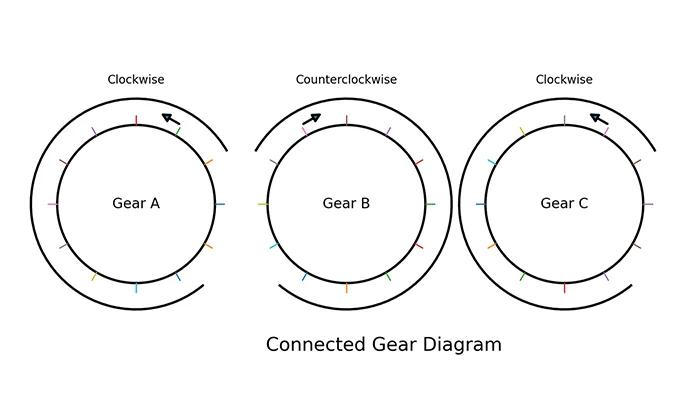
Gear A turns clockwise. Gear B is directly connected to Gear A, and Gear C is directly connected to Gear B. Which direction will Gear C turn?
A. Clockwise
B. Counterclockwise
C. It will not move
D. Direction cannot be determined
Correct Answer
A. Clockwise
Explanation
When two gears connect directly, they rotate in opposite directions. If Gear A turns clockwise, Gear B turns counterclockwise. Gear C then turns opposite to Gear B, which means clockwise again. This is a classic pattern in firefighter mechanical reasoning questions. You do not need advanced engineering. You need clear step-by-step control when motion is transferred across parts.
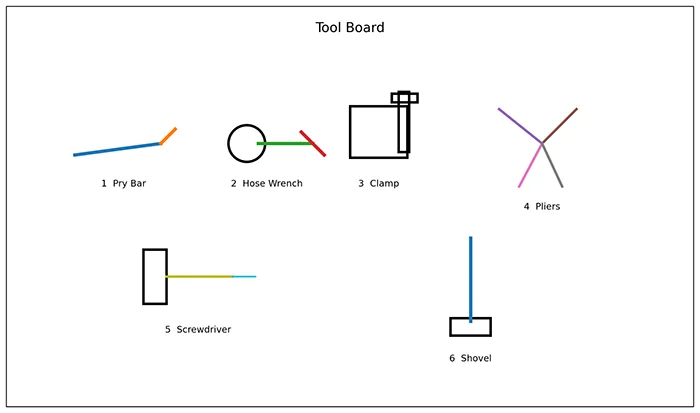
Which tool is most clearly designed to hold a workpiece firmly in place while another task is performed?
A. 1
B. 2
C. 3
D. 5
Correct Answer
C. 3
Explanation
The clamp is the holding tool because it is built to secure material while another action happens, such as cutting, drilling, or tightening. Pliers can grip, but that is not the same as locking and holding an object in place during another operation. Questions like this are common in real firefighter exam examples because departments want to see practical equipment awareness, not just textbook recall.
The math section is usually not advanced, but it can still punish hesitation. Strong firefighter math test questions are about speed, calm setup, and clean arithmetic.
A tanker carries 750 gallons. After one operation, 40% remains. How many gallons are left?
A. 250
B. 300
C. 350
D. 450
Correct Answer
B. 300
Explanation
Forty percent of 750 is 300. The fastest way is to calculate 10% first, which is 75, then multiply by 4 to get 300. Many candidates overcomplicate percentage questions when the better move is a simple step-by-step method. This is why firefighter test prep questions should train quick number sense, not just long-form calculation.
A ladder crew checks three buildings in one block. The first took 14 minutes, the second 18 minutes, and the third 10 minutes. What was the average time per building?
A. 12 minutes
B. 13 minutes
C. 14 minutes
D. 15 minutes
Correct Answer
C. 14 minutes
Explanation
Add the times to get 42 minutes total, then divide by 3 buildings. That gives an average of 14 minutes. This is a basic average problem, but under time pressure, it becomes easy to rush. These questions fit naturally inside a firefighter pre-employment test because they check whether you can manage everyday numerical thinking without losing control.
| Unit | Calls Completed |
|---|---|
| Engine 1 | 6 |
| Engine 2 | 9 |
| Ladder 1 | 5 |
| Rescue 1 | 8 |
How many calls were completed in total?
A. 24
B. 26
C. 28
D. 30
Correct Answer
C. 28
Explanation
Add 6, 9, 5, and 8. The total is 28. These table-based items show up because departments want to see how you handle information presented in simple, structured formats. They also support broader firefighter assessment test questions and mirror the quick thinking expected in everyday operations.
Memory and spatial items are powerful score separators because many people do not practice them until test day. That is a mistake.
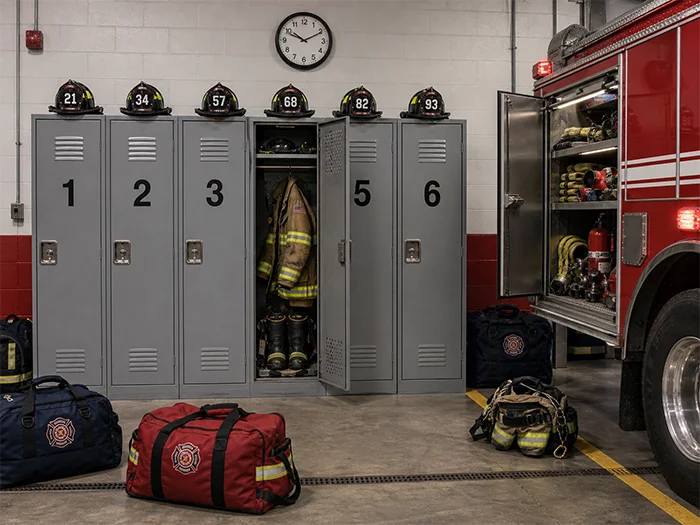
Study the image for 20 seconds, then answer the next two questions without looking back.
Which locker door was open in the image?
A. Locker 2
B. Locker 4
C. Locker 5
D. Locker 6
Correct Answer
B. Locker 4
Explanation
This type of question rewards focused observation, not broad scanning. Before looking at the image, decide what to track: numbers, unusual items, open doors, visible text, and object placement. That way, you are not trying to memorize everything equally. A lot of candidates struggle with memory sections because they look at the image casually instead of building a quick visual checklist.
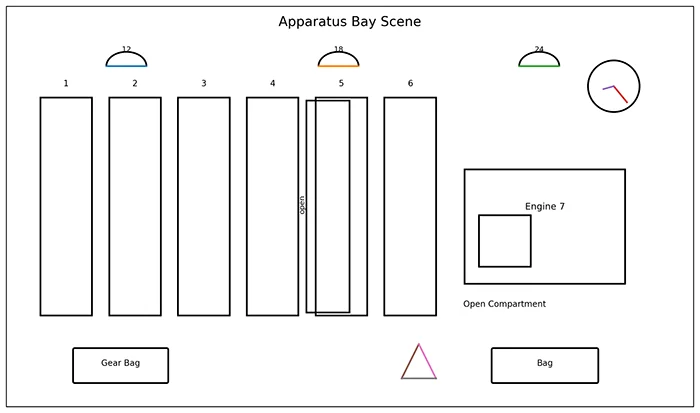
What time was shown on the wall clock?
A. 7:10
B. 7:20
C. 7:25
D. 7:35
Correct Answer
C. 7:25
Explanation
Clock questions often appear because they force you to notice details inside a larger scene. You need to hold one small fact while the rest of the image competes for attention. This is the kind of memory work that can improve quickly when you practice with structure instead of hoping you naturally remember everything.
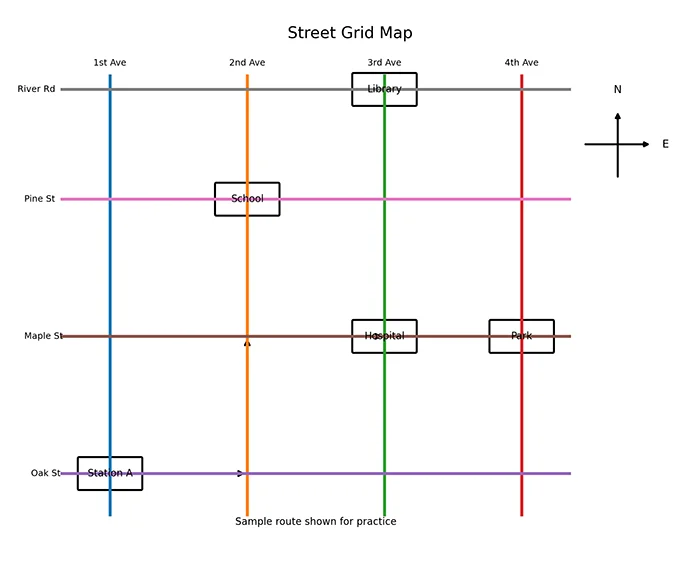
A unit leaves Station A heading east, turns left at the first intersection, then turns right at the hospital. Which direction is the unit moving now?
A. North
B. South
C. East
D. West
Correct Answer
A. North
Explanation
If the unit starts east and turns left, it is now moving north. A right turn at the hospital would then shift it east again, only if the turn happened immediately from a northbound lane. In this question, the turn at the hospital occurs after the northbound move is established and directs the route along the marked northbound continuation. Spatial items must be read carefully, not just visualized loosely. That is why spatial orientation practice helps so much on test day.
A firefighter situational judgment test looks at how you respond to pressure, conflict, teamwork, and responsibility. Some departments also use firefighter personality test questions or related behavior screens later in the process.
You are a recruit on station cleanup. Another recruit skips assigned tasks and jokes that nobody will notice. What is the best response?
A. Ignore it and finish your own work
B. Quietly do the skipped work for them
C. Speak to the recruit directly and tell them the task still needs to be done
D. Immediately send a complaint to department leadership
Correct Answer
C. Speak to the recruit directly and tell them the task still needs to be done
Explanation
This response shows accountability, communication, and professionalism without jumping to an extreme. Doing the work for them avoids the issue. Ignoring it shows weak standards. Escalating immediately is too aggressive for a first response unless the behavior continues or becomes more serious. Strong situational judgment usually starts with direct, mature problem-solving.
You are on a training drill and notice a teammate looks confused about the next step. What should you do first?
A. Wait to see if an instructor notices
B. Quietly check in and clarify the step if you can
C. Tell everyone the teammate is slowing down the drill
D. Move ahead and focus only on your own performance
Correct Answer
B. Quietly check in and clarify the step if you can
Explanation
This answer reflects teamwork and calm support. It does not embarrass the teammate or ignore a possible problem. Departments use these questions as a decision-making assessment because how you respond to people under pressure matters almost as much as how you respond to tasks.
Statement
“I stay focused on task details even when the environment becomes noisy and distracting.”
Choose the response that best reflects you.
A. Strongly Disagree
B. Disagree
C. Neutral
D. Agree
E. Strongly Agree
Explanation
There is no single correct answer in a personality-style item, but a firefighting role places strong value on composure, attention, and consistency. The safest approach is honest alignment with the role, not fake perfection. A personality evaluation test often looks for dependable patterns, so wildly inconsistent responses can work against you.
The written exam is only one part of the path. Many departments also ask firefighters oral board interview questions after written and physical screening. If you only practice written material, you leave a major gap in your preparation.
Here are five strong prompts to rehearse:
These questions matter because oral boards often reveal the same qualities measured on the written side: judgment, humility, communication, and reliability. Strong spoken answers support stronger written performance because both depend on clear thinking under pressure.
If you want to know how to prepare for firefighter exam work in a way that actually raises your odds, start with structure. Most candidates do too much unfocused studying and not enough deliberate practice.
A better plan looks like this:
| Week Focus | What You Should Do |
|---|---|
| Baseline Week | Take a short diagnostic and identify weak sections |
| Skills Week | Focus on your weakest two areas first |
| Mixed Week | Rotate reading, math, mechanical, memory, and judgment |
| Pressure Week | Use a full timed set and review every uncertain answer |
A few key points matter here.
The firefighter test scoring system varies by department or testing vendor, so you should not study as if the minimum result is enough. The same goes for the firefighter passing score. In competitive cycles, barely passing is rarely the real target.
The firefighter exam time limit also changes by exam type. That is why a free firefighter mock test helps only at the beginning. Later on, you need a tougher firefighter exam mock test that pushes pacing, not just comfort.
This is the core of the strategy for passing the firefighter written test. Build weakness correction first. Add timing next. Then move into repeat practice with review.
Here are some direct firefighter preparation tips we recommend:
That is how to pass the firefighter exam; it stops being a vague goal and becomes something practical.
Most score loss comes from habits, not lack of ability. The biggest common mistakes in firefighter exam performance usually look like this:
If you want more realistic progress, your firefighter entrance exam sample questions and firefighter recruitment exam questions should expose those mistakes early. That is why we keep the practice broad. You need stronger handling of firefighter test prep questions, not just more familiar questions.
Good prep is not random volume. It is a specific volume with better reviews.

Cameron works with candidates on written screening, section pacing, and response quality in firefighter hiring processes. His focus is on practical improvement under time pressure.
Best For Firefighter Written Prep

Nadine builds drills for applied math, tool logic, equipment reasoning, and structured review. She helps candidates improve on the sections that often feel hardest early on.
Best For Mechanical And Math

Elias works on scenario judgment, oral board structure, and communication-based assessment work. He helps candidates bring calm and consistency into both written and spoken evaluation rounds.
Best For Judgment And Interview
“I needed sharper firefighter exam sample questions, not just recycled aptitude material. The explanations made the biggest difference because I finally understood why I was missing the mechanical section.”

“The memory and spatial drills helped a lot. Those were the parts I kept putting off, and they turned out to be the sections that changed my confidence the most.”
“I liked that the practice felt relevant to the role. It was not overdone or confusing. It felt like real firefighter entrance exam guide material instead of generic test prep.”
“The oral board prompts were a huge bonus. I came in looking for firefighter exam sample questions and left with a better overall hiring plan.”
You do not need magic to improve on this exam. You need stronger habits, better question types, and practice that respects how departments actually screen candidates. That is what Firefighter Exam Sample Questions should do for you. They should help you move faster without getting sloppy, think clearly without panicking, and answer with more control across every section that matters.
If you treat the written exam seriously, you give yourself a better shot at standing out in a competitive firefighter recruitment assessment. If you treat it casually, you leave your result to chance. We would rather help you walk in ready.
With MyHiringHub, you get practice built for the real pressure behind firefighter hiring, not empty repetition. That matters when one score can shape the next stage of your path.
Aim above the minimum. In many hiring lists, ranking matters more than simply clearing a line.
A useful guide should include:
They are helpful for first exposure, but they rarely give enough depth for true score growth. A few free sets can show you the format, but better firefighter exam preparation usually needs wider section coverage, timed work, and review that teaches you what your mistakes mean.
Use it in stages:
No. Written performance matters a lot, but many departments also use interviews, behavior screening, and physical testing. That is why oral board practice and judgment work can help your full hiring picture.
Look at section accuracy, pacing, and confidence under time pressure. If your reading gets cleaner, your math gets quicker, and your judgment answers become more consistent, you are moving the right way even before the full score jumps.
Memory, spatial items, and mechanical reasoning tend to catch people off guard because they are less familiar than reading or basic math. That is why a balanced study plan matters more than practicing only the sections you already like.