The Free Caliper Assessment Practice Test is not just about seeing a few sample items before the interview stage. It is about understanding how the assessment thinks, how employers use it, and how your responses can position you as a stronger match for the role in front of you.
The Caliper assessment sits in a different category than most hiring tests. It is not built only around right and wrong answers. It blends job-relevant behavior, motivation, and reasoning. That makes preparation more strategic. A candidate who trains only on generic logic questions misses half the battle. A candidate who treats it like a pure personality quiz misses the other half.
MyHiringHub helps candidates work through that complexity with sharper role alignment, stronger response discipline, and practice that feels closer to the actual decision pressure of a caliper pre-employment assessment.
A clear answer to what the caliper assessment test matters because many candidates approach it with the wrong mindset. The Caliper assessment, now under Talogy, is a workplace assessment used to evaluate job fit through personality patterns, motivations, and one cognitive component tied to abstract reasoning. Talogy describes it as containing 98 questions, being untimed, and usually taking around 60 to 75 minutes.
That means a real caliper hiring test is not simply a test of knowledge. It is a layered decision tool. Employers use it to compare a candidate’s profile against role expectations through job models and selection reports rather than a simple pass-fail result. Talogy’s support materials explain that job models drive job-fit scores and that selection reporting is built around how closely a candidate fits a role. This is why strong caliper test preparation needs two tracks at once:
Many candidates think the Caliper is one long personality questionnaire. That is only partly true. The current official design describes three main item types within the assessment: forced-choice items, Likert-scale items, and abstract reasoning items. The same source explains that most items are personality-driven and that abstract reasoning is the only area with objectively correct and incorrect answers.
Here is a practical view of the caliper test format and caliper assessment structure you should keep in mind:
| Assessment Area | What You Face | What It Reveals |
|---|---|---|
| Forced Choice | Pick what is most like you and least like you | Behavioral tendencies and priorities |
| Likert Scale | Rate how much you agree with a statement | Consistency, style, flexibility and work habits |
| Abstract Reasoning | Pattern, analogy, and sequence items | Fluid reasoning and problem-solving |
This structure is why the caliper test difficulty level can feel surprisingly high. You are being evaluated on multiple dimensions, and the style keeps shifting. You need thoughtful answers, but you also need consistency.
Talogy states that the Caliper Profile measures 21 personality traits and one cognitive ability, abstract reasoning. Their scoring materials explain that those traits combine into behaviors and competencies that are then mapped against job models.
In practical hiring terms, that means employers are often looking for patterns such as:
That is why caliper behavioral test questions matter so much. A sales role may reward drive, resilience, and influence. A finance role may put greater weight on discipline, precision, and consistency. A manager may need a stronger decision style, delegation comfort, and steadiness under pressure.
This also explains why there is no one universal “best” profile. There is only a stronger fit for the job being evaluated.
The caliper assessment scoring system is often misunderstood. Candidates search for a cutoff score when the better question is how the profile gets interpreted against the role. Talogy’s support content explains that job-fit scores depend on the job model selected and that fit is only as useful as the match between the role and the model being used. Their report materials also describe selection reports that show how closely an applicant fits the target role.
So when thinking about caliper assessment results explained, keep this in mind:
| Candidate Concern | What Actually Matters |
|---|---|
| “Did I pass?” | Employers use fit data, not a simple pass-fail grade |
| “Can I get one perfect score?” | Fit depends on the target role |
| “Will one answer ruin me?” | Patterns and consistency matter more than one isolated response |
| “Can I fake the ideal profile?” | Forced-choice design reduces obvious gaming |
Talogy also advises employers not to treat Caliper as the only hiring data point and to use the assessment as one part of a broader decision process.
That makes strong preparation even more valuable. The aim is not to game the system. The aim is to present a profile that is aligned, thoughtful, and credible.
This is where most candidates either help themselves or quietly damage their fit.
The personality portion is designed to compare your tendencies against the role. That means caliper personality assessment answers should not feel random or purely emotional. They should reflect how you would actually function successfully in the job you want.
These items ask you to choose what is most like you and least like you from a group of statements. The challenge is not only picking one good line. The challenge is understanding the trait tradeoff behind the group.
Choose which statement is most like you and least like you:
For many leadership, operations, and fast-paced commercial roles, “Keep projects moving when the team loses momentum” or “Adjust quickly when conditions shift” may look stronger than “Avoid conflict even when a decision is needed.” The point is not to pick what sounds noble. The point is to reflect functional behavior tied to the job.
These items are closer to agreement ratings and demand consistency across the full assessment.
Rate your agreement with this statement:
“I stay productive even when priorities change with little warning.”
A stronger answer often signals adaptability and self-management. That can matter heavily in roles that require change tolerance, cross-functional work, or customer pressure. In highly procedural environments, the strongest answer may still be positive, but your full pattern across other items becomes more important than one statement.
These are the kinds of caliper assessment examples that help candidates stop guessing at surface-level wording and start thinking in role-relevant traits.
The cognitive side is smaller than the personality side, but it still matters because it shows how you process patterns, analogies, and logic. Talogy identifies abstract reasoning as the cognitive ability measured on the Caliper Profile. Get to know it with our Caliper Profile test prep.
A good caliper assessment practice test should include varied cognitive items, not just one pattern type. That is where caliper test practice questions, caliper assessment questions and answers, and a structured caliper assessment simulation test become useful.
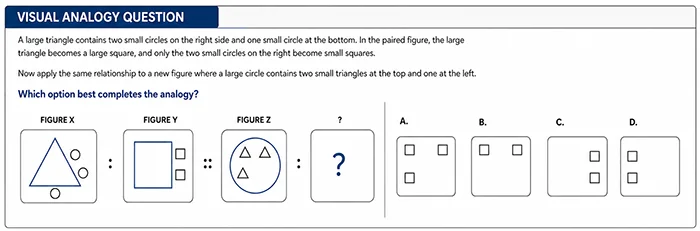
A large triangle contains two small circles on the right side and one small circle at the bottom. In the paired figure, the large triangle becomes a large square, and only the two small circles on the right become small squares.
Now apply the same relationship to a new figure where a large circle contains two small triangles at the top and one at the left.
Which option best completes the analogy
A. Large square with two small squares at the top and one square at the left
B. Large square with two small squares at the top only
C. Large rectangle with two small rectangles at the top
D. Large rectangle with one small rectangle at left and one at bottom
Correct answer
B
Explanation
The relationship changes only the small shapes that match the specific marked positions in the original pattern. Since only the two top small triangles match the relevant relationship, only those become squares in the answer.
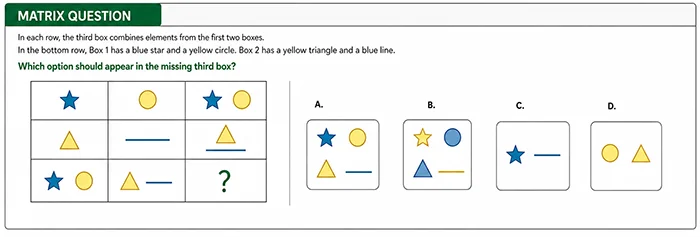
In each row, the third box combines elements from the first two boxes. In the bottom row, Box 1 has a blue star and a yellow circle. Box 2 has a yellow triangle and a blue line. Which option should appear in the missing third box
A. Blue star, yellow circle, yellow triangle, blue line
B. Yellow star, blue circle, blue triangle, yellow line
C. Blue star and blue line only
D. Yellow circle and yellow triangle only
Correct answer
A
Explanation
The row rule combines all elements while keeping their original colors.
5 | 9 | 18 | 22 | 44 | 48 | ? | ?
A. 96 and 100
B. 92 and 96
C. 96 and 104
D. 88 and 92
Correct answer
A
Explanation
The pattern alternates between +4 and ×2.
5 to 9 is +4
9 to 18 is ×2
18 to 22 is +4
22 to 44 is ×2
44 to 48 is +4
48 to 96 is ×2
96 to 100 is +4
A black arrow rotates 90 degrees clockwise in each frame, while a white dot moves one position counterclockwise around the border. If the arrow starts pointing up and the dot starts in the top right, where are they after three moves
A. Arrow left, dot bottom right
B. Arrow right, dot bottom left
C. Arrow left, dot top left
D. Arrow down, dot bottom left
Correct answer
A
Explanation
Up, right, down, left for the arrow after three moves gives left.
Top right, top left, bottom left, bottom right, for the dot after three counterclockwise moves gives bottom right.
These are not copied real caliper assessment questions, but they reflect the kind of pattern logic strong candidates should train on. That makes them useful as a caliper test free sample, a caliper practice test with answers, and part of a larger caliper assessment mock test routine.
Practice Caliper Cognitive Skills
A strong answer to how to pass the caliper assessment test starts with dropping two bad strategies.
The first bad strategy is trying to sound perfect. Overmanaged responses often create contradictions across the personality sections.
The second bad strategy is ignoring the role. The Caliper does not reward one universal profile. It rewards believable alignment with the job model.
A better approach looks like this:
These caliper assessment tips help because they focus on credibility, alignment, and clarity. They do not depend on trying to outsmart the assessment. They help you present a stronger, more coherent match.
A serious service around caliper test preparation should give you more than a few personality statements and one or two puzzle sets. It should help you build a complete response strategy. That means combining:
A timed drill still has value because it teaches focus and reduces overthinking on the cognitive items. It also helps you compare clean reasoning against rushed guessing.
For candidates who want a broader Free Caliper Assessment Practice Test experience, that mix is where real improvement happens.
MyHiringHub supports that process by making the practice more organized, more role-aware, and far more useful than scattered answer sheets.

Talia works on hiring assessment preparation with a strong focus on personality interpretation and role alignment. She helps candidates understand how work traits appear in statement patterns and how to respond with stronger consistency.

Evan specializes in cognitive assessment practice and fast pattern recognition. His work focuses on visual analogies, sequence logic, and cleaner review methods for abstract reasoning sections.

Simone develops preparation frameworks for workplace assessments used in hiring and promotion. Her focus is on helping candidates connect job demands to assessment behavior without sounding forced or artificial.
“I had never taken a Caliper assessment before, so I assumed it was just a personality quiz. The role-based practice changed everything. I started seeing the logic behind the statements.”

“The cognitive questions were not impossible, but they were definitely harder than I expected. The answer explanations made the biggest difference for me.”
“I liked that the prep did not push fake perfection. It helped me think about the role and answer in a way that felt credible.”
“The forced-choice practice was the most useful part. It made me realize how much the wording matters and how quickly you can create contradictions without noticing.”
“The mix of behavioral and cognitive practice felt much closer to the real thing than the random materials I had looked at before.”
“I wanted something more strategic than a list of questions. This gave me a better way to think through the entire assessment.”
A strong performance on the Caliper is rarely about one perfect answer. It is built through repeated exposure, better role awareness, and stronger consistency across the full assessment.
Treat the personality sections as job-fit communication, not personal confession. Treat the cognitive items as pattern discipline, not raw intelligence theater. And treat preparation as a business decision. When the role matters, the assessment deserves real effort.
MyHiringHub gives candidates a stronger path into that effort through focused support, practical strategy, and smarter preparation for the assessment that may shape the next hiring conversation.
No. Talogy describes the Caliper Profile as untimed, with most people taking about 60 to 75 minutes to complete it.
Not in the simple way candidates often expect. The assessment is generally used as a fit measure against a role-specific job model rather than a universal pass-fail cutoff.
Talogy’s reporting materials show that employers can receive selection-oriented reports built around job fit, behaviors, and competencies linked to a specific role model. That means your result is interpreted in context, not as a single raw score with one fixed meaning.
The personality sections reward full engagement and consistency, so jumping mentally without a system usually hurts more than it helps. The smarter move is to stay steady, read each statement carefully, and keep the role in mind across the full assessment.
The caliper test difficulty level often comes less from time pressure and more from the complexity of interpretation. Many candidates find it difficult because it mixes role-fit personality work with cognitive questions and does not give them obvious “right answer” cues across most of the test.
Yes, for two reasons:
Talogy’s guidance to employers says Caliper should be one of multiple data points rather than the sole basis for a hiring decision. Interviews, experience, and other information still matter.