Pre-Employment Personality Tests are used to judge how your natural work style may fit a role, team, manager, and company culture. They are not usually looking for one perfect personality. They are looking for patterns. Your answers can suggest how you handle pressure, structure, teamwork, leadership, conflict, detail, pace, and accountability.
That is why guessing your way through a personality test for employment can hurt you, and you need McQuaig test prep. A rushed answer may look harmless in one question, but repeated contradictions can create a weak profile. Strong preparation helps you understand what the employer is reading behind each statement, so your answers stay honest, consistent, and role-aware.
MyHiringHub helps candidates practice with realistic question formats, explanations, and work style guidance. The goal is not to fake a personality. The goal is to communicate your strongest professional traits clearly within a hiring assessment.
A personality employment test helps hiring teams compare work behaviors that are hard to see in a resume. Employers may use it before interviews, after interviews, or alongside cognitive and skills tests. Some assessments focus on leadership potential. Others focus on sales drive, service mindset, reliability, emotional control, safety judgment, or team fit.
A pre-employment personality test may be part of a wider recruitment process for customer support, management, healthcare, logistics, retail, finance, sales, law enforcement, graduate hiring, and corporate roles. The employer is usually asking a practical question about how your behavior fits the job.
| Work trait | What the employer may infer | Strong signal |
|---|---|---|
| Conscientiousness | Reliability and follow-through | Organized, careful, consistent |
| Sociability | Comfort with people | Communicative, approachable, engaged |
| Assertiveness | Influence and decision style | Direct, confident, controlled |
| Stability | Response under pressure | Calm, steady, resilient |
| Openness | Learning and adaptation | Curious, flexible, improvement-focused |
| Rule orientation | Policy and safety behavior | Responsible, structured, compliant |
This is why a personality assessment for job preparation should begin with the role. A strong answer for a sales position may not be the strongest answer for an accounting role. A strong answer for leadership may not be ideal for a role built around independent technical work.
Different companies use different personality assessments for employment, but many formats repeat across major test providers. You may face short statements, ranked traits, most and least choices, adjective checklists, workplace scenarios, or combined behavior and reasoning screens.
| Format | What you do | What to watch |
|---|---|---|
| Likert scale | Rate agreement with a statement | Avoid careless extremes |
| Forced choice | Pick the most and least accurate option | Every selection carries meaning |
| Ranking | Order traits by fit | Keep the role in mind |
| Adjective checklist | Select words that describe you | Stay consistent across similar traits |
| Situational style | Choose a workplace response | Balance judgment and action |
| Profile comparison | Describe yourself and expected behavior | Avoid a large gap unless it is realistic |
A personality survey for employment may ask how you see yourself. A personality profile test for employment may compare your natural style with workplace expectations. A personality exam for employment may combine several formats in one sitting. The name changes, but the core challenge stays the same: your answers must form a believable professional pattern.
The safest approach is honest, but not casual. You should answer as your real professional self, not your worst day or your most exaggerated version. Employers do not expect everyone to be equally outgoing, analytical, patient, competitive, structured, and creative. They expect a profile that makes sense for the role.
Before answering, think about three things. First, what does the role require daily? Second, which option honestly reflects you at work? Third, will this answer conflict with the image you have already created? That is the foundation of a strong personality test for pre-employment screening.
If a job needs close accuracy, showing low attention to detail can weaken your profile. If a role needs client communication, very low social comfort may raise concerns. If a leadership role requires decisions under pressure, constant avoidance of responsibility can look risky.
A good response pattern should show maturity. You can be ambitious without sounding reckless. You can be cooperative without sounding passive. You can be detail-focused without sounding rigid. That balance matters in a pre-employment personality test because the assessment is reading patterns, not one isolated answer.
These examples are original and written to reflect common pre employment personality testing formats. The answer guidance shows how to think, not what every candidate must select.
Likert scale statement
I prefer to finish one task before starting another.
A. Strongly Disagree
B. Disagree
C. Neutral
D. Agree
E. Strongly Agree
Answer thinking
For roles involving compliance, accounting, quality review, or operations, Agree or Strongly Agree may show focus and task discipline. For roles requiring constant multitasking, such as customer support or event coordination, Agree may still work, but Strongly Agree could suggest low flexibility. The best response depends on the role and your real work habits.
Choose one statement as ‘Most Like Me’ and one statement as ‘Least Like Me’.
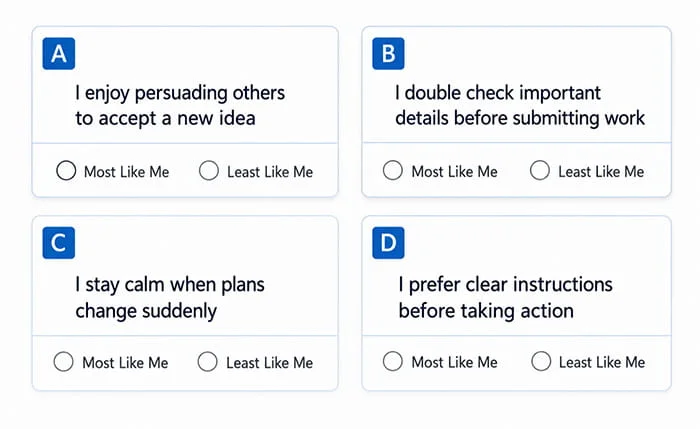
A. I enjoy persuading others to accept a new idea
B. I double-check important details before submitting work
C. I stay calm when plans change suddenly
D. I prefer clear instructions before taking action
Answer thinking
For sales, business development, or leadership, A may be a strong Most choice. For quality assurance, finance, or healthcare administration, B may carry more value. For emergency support or customer service, C can show composure. D can be positive in regulated work, but if selected too often, it may suggest hesitation in unclear situations.
Rank order prompt
Rank these traits based on how well they describe you at work.
Practical
Competitive
Patient
Analytical
Answer thinking
A management role may value Practical, Analytical, and Competitive in a balanced order. A counseling or patient support role may place the patient higher. A data role may favor Analytical. A sample employment personality test is useful because it teaches you to connect traits with job context before ranking.
Workplace response prompt
A teammate gives you incomplete information before a client update. What is your most likely response?
A. Send the update anyway to keep things moving
B. Ask for the missing details and adjust the message if needed
C. Tell the manager the teammate caused the issue
D. Delay everything until the teammate provides a perfect response
Best answer thinking
B shows accountability, communication, and practical judgment. A may create an accuracy risk. C sounds blame-focused. D may show standards, but it can also suggest poor urgency control. Many job application personality test questions reward steady professional judgment over dramatic action.
A personality test for hiring is usually built around job-relevant traits. Some assessments focus on everyday work preferences. Others focus on leadership risk, motivation, team behavior, or pressure response. You may encounter tests similar to Hogan, Caliper, Predictive Index, SHL OPQ, Saville, PAPI, Plum, McQuaig Word Survey, or other employer-specific tools.
The assessment may not tell you exactly which trait is being measured. A simple statement about liking clear rules may connect with formality or structure. A statement about introducing people may connect with sociability. A statement about pushing for results may connect with dominance, drive, or ambition. A question about staying calm under stress may connect with emotional steadiness.
This is why a workplace personality test free practice option can be a helpful first step, but deeper preparation should include explanations. You need to know why a response matters, not just what the option says.
A personality test for hiring employees can also help companies compare candidates for different roles. A high persuasion style may be great for sales. A high patience style may fit support or operations. A high structure style may fit compliance. A high independence style may fit technical work, but it may need balance in team-heavy roles.
A free personality assessment test for jobs can give you a quick introduction, but serious candidates usually need more structure. A strong practice experience should help you read questions, understand trait signals, and stay consistent without sounding robotic.
Good preparation should include:
A free work personality test can help you see your natural tendencies, while a guided employment personality assessment helps you understand how those tendencies may appear in a hiring context. The difference is important. A casual quiz may describe you. A hiring screen evaluates fit against the job.
MyHiringHub focuses on that hiring context. Candidates can practice the style, review the logic behind answer choices, and approach the real assessment with a clearer professional profile.
The same answer can carry different meanings across jobs. A candidate applying for a warehouse safety role should show reliability, rule awareness, and calm response under pressure. A candidate applying for an account executive role should show persuasion, energy, resilience, and relationship confidence. A candidate applying for a project coordinator role should show organization, follow-through, and balanced communication.
| Role type | Traits often valued | Watch for |
|---|---|---|
| Sales | Persuasion, drive, resilience | Overly aggressive answers |
| Customer support | Patience, empathy, and composure | Low service orientation |
| Management | Accountability, influence, decision making | Extreme control or weak ownership |
| Finance | ||
| Operations | Reliability, pace, structure | Low follow-through |
| Creative roles | Adaptability, ideas, and collaboration | Poor deadline discipline |
A personality test pre employment process can feel personal, but the employer is usually reading job behavior. You do not need to become someone else. You need to show the professional strengths that are real and relevant.
A pre-employment personality test can also compare your answers across similar themes. If you say you love pressure, but later avoid responsibility, the profile may look unstable. If you claim to be extremely social but choose every independent option, the pattern may weaken.
Free practice is useful when you are new to personality screening. It can help you understand formats and reduce anxiety. A workplace personality test free sample is especially helpful for seeing Likert statements, forced choice sets, and ranking prompts.
Free practice may not be enough when the job is highly competitive, the role includes leadership responsibilities, or you have failed a similar assessment before. In those cases, you may need deeper review, role-specific thinking, and a clearer explanation of trait signals.
A personality test, pre employment screening stage, can be just as important as an aptitude test. Many candidates prepare hard for numerical reasoning and ignore personality questions because they look simple. That is a mistake. Simple wording can still produce a weak profile when answers are rushed.
The right approach is not overthinking every line. The right approach is controlled consistency. Read carefully, answer professionally, and keep the role in view.

Grant works with candidates preparing for behavioral hiring screens, leadership style assessments, and workplace fit evaluations. His coaching focuses on answer consistency, role alignment, and avoiding exaggerated response patterns.

Tessa specializes in forced-choice and ranking-based personality questions. She helps candidates understand how small answer decisions can influence an overall work style profile.

Nina supports candidates preparing for customer-facing, management, and operations roles. Her work connects real job expectations with clear assessment response strategies.
“The most helpful part was learning how each answer connected to a workplace trait. I stopped trying to pick the answer that sounded perfect and started thinking about the role.”

“I had taken a personality assessment before and felt confused by the forced-choice questions. The practice made the format feel much less strange.”
“The examples were practical and not generic. I liked the way the explanations showed how answers can change depending on the job.”
“I was applying for a supervisor role, so I needed to show leadership without sounding controlling. The guidance helped me find that balance.”
“The review process helped me notice contradictions. I was presenting myself as highly independent in one section and extremely team dependent in another.”
Before taking a pre employment personality assessment test, read the job description again. Highlight the behaviors the employer appears to value. Look for words such as accuracy, collaboration, initiative, safety, customer service, leadership, independence, resilience, or attention to detail.
Then think about real work examples that support those traits. This keeps your answers grounded. If you know you have handled difficult customers calmly, you can answer composure questions with more confidence. If you know you regularly organize team deadlines, you can answer planning questions without hesitation.
Do not try to game every response. Most hiring tests are built to notice unrealistic patterns. Very extreme answers across too many positive traits can look less believable than a balanced, mature profile.
A personality test for hiring should be approached with the same seriousness as any other pre employment test. Use practice to understand the format, then answer as the strongest, accurate version of your professional self. MyHiringHub helps you practice that balance before the assessment starts.
Pre-Employment Personality Tests are hiring assessments that measure work style, motivation, behavior, and job fit. They help employers understand how a candidate may communicate, handle pressure, follow rules, lead, or work with others.
Yes, but not in the same way as a math test. A result can be considered weak if your profile does not match the role, shows contradictions, or suggests behavior that may not fit the workplace.
Use a balanced approach:
No. Choosing the most impressive answer every time can look unrealistic. A strong profile usually shows strengths, judgment, and natural balance. Employers are not looking for a perfect person; they are looking for a believable fit.
Forced-choice questions make you choose between several positive traits. This is harder than a simple agree or disagree item because each option may sound good. The best selection depends on which trait matters most for the job and which one honestly reflects your work behavior.
Most personality tests measure tendencies rather than hard skills. They may show how you prefer to work, communicate, decide, plan, or respond under pressure. Some assessments combine personality with cognitive or reasoning sections.
Practice helps you understand what traits are being signaled. You can review sample questions, compare role demands, and spot contradictions in your answers. That makes your final responses more consistent and professional.
Start before the employer sends the assessment link if the role matters to you. Early practice gives you time to understand the formats without rushing, especially for forced-choice and ranking questions.