The Free Hogan Assessment Practice Test is one of the smartest starting points if you are heading into a hiring process that uses Hogan testing. These assessments are not simple personality quizzes. They are structured workplace tools built to evaluate how you show up at work, how you may behave under pressure, what drives your decisions, and how well you reason through business problems.
Hogan is widely used in hiring, development, leadership evaluation, and high-potential talent identification, which means your performance can shape much more than a single interview outcome.
If you are serious about getting ready, you need more than random examples. You need a clear understanding of the Hogan assessment suite overview, the question styles used in each part, and the decision traps that lead candidates to weak or inconsistent answers. We help you practice with structure so you can approach the assessment with stronger judgment and a better sense of what employers are actually reading in your profile.
You are not here for theory alone. We will definitely get you through the Hogan practice pack. You are here to get usable practice and a smarter response strategy. That is exactly how we have built this guide.
This content is built to help you move with purpose, not guess your way through the assessment.
The Hogan system usually centers on four well-known parts. The HPI measures everyday workplace behavior and is often described as the bright side of personality. The HDS measures the dark side of personality, meaning patterns that can hurt performance when pressure rises.
The MVPI measures internal motives, values, and preferences that shape cultural fit and long-term engagement. The HBRI focuses on reasoning style and problem-solving in business settings. Together, these tools support standardized personality profiling, predictive job performance, and development decisions across many job levels.
Much of this framework connects to socioanalytic theory, which examines how people get along, get ahead, and make sense of their roles in the social world. Hogan also draws on the five-factor model FFM and related personality research to ground its scales in established psychometric thinking. That is one reason employers trust the system for selection, coaching, and executive development.
| Assessment | What It Measures | What Employers Watch Closely |
|---|---|---|
| HPI | Bright side of personality | Day-to-day strengths, teamwork and reliability |
| HDS | Dark side of personality | Risk patterns under stress, derailment risk |
| MVPI | Values and motives | Value-based culture fit, drivers, interests |
| HBRI | Business reasoning | Cognitive reasoning capability, judgment, logic |
Many candidates assume there is no way to prepare because personality assessments do not work like math tests. That idea causes avoidable mistakes. Practice helps you see response patterns, understand the balance between authenticity and judgment, and reduce contradictions that can damage your profile. A strong Hogan assessment practice test free experience gives you a chance to see how repeated wording can test consistency, how extreme answers can create risk, and how role context changes the meaning of a result.
This matters even more when employers use Hogan for occupational scale performance, professional derailment prevention, and executive coaching assessment. Your result is not just a score. It becomes a narrative about how you work with others, handle authority, respond to pressure and are likely to thrive in the target role.
The HPI measures your bright side of personality, or how you tend to behave when things are going reasonably well. Hogan describes it through seven primary scales and a larger set of subscales. Some examples include adjustment and ambition scales, interpersonal approach, prudence, curiosity, and learning orientation. Employers often use this area to judge leadership style, team fit, emotional steadiness, and workplace image.
This is where Hogan Personality Inventory practice becomes valuable. A weak strategy here is trying to look perfect. A better strategy is showing a work-ready pattern that feels grounded, credible, and aligned with the role.
Rate your agreement with the statement below
I stay composed when sudden changes disrupt my plan
Strongly Disagree
Disagree
Agree
Strongly Agree
This type of item can relate to emotional steadiness and work composure. If you always chase the most polished answer, you may overstate calmness and lose credibility.
Rate your agreement with the statement below
I like taking charge when a team loses direction
Strongly Disagree
Disagree
Agree
Strongly Agree
This kind of item can connect to ambition, initiative, and visible leadership style. It can also affect how employers view your fit for people leadership versus support-heavy roles.
The HDS measures the dark side of personality. These are tendencies that may remain quiet under normal conditions but become disruptive under stress, boredom, pressure, or frustration. Hogan specifically positions this tool around reputation risk and derailment. This is why it matters for leadership selection and for preventing professional derailment.
This part often surprises candidates because traits that seem useful in moderation can become problematic when overused. Confidence can become arrogance. Caution can become paralysis. Detail focus can become rigidity. That is why Hogan development survey tips should focus on balance and self-awareness rather than fake perfection.
Rate your agreement with the statement below
When I lose trust in a coworker, I rarely give them another chance
Strongly Disagree
Disagree
Agree
Strongly Agree
This kind of statement can reveal pressure-driven patterns around skepticism, forgiveness, and relationship repair.
Rate your agreement with the statement below
I prefer to review every detail myself before letting others move ahead
Strongly Disagree
Disagree
Agree
Strongly Agree
This may be connected to perfectionism, control, and the risk of over-management. In some roles, moderate caution helps. In others, it can signal bottlenecks.
The MVPI is about what drives you. Instead of focusing on visible behavior, it looks inward at your interests, priorities, and preferred work environment. Hogan frames this assessment around values, motivation, and the kind of culture or work setting that will energize someone over time. This is a major part of value-based culture fit and long-term performance alignment.
The MVPI matters because someone can have the right personality for a role but still clash with the culture. That is where core values and motives, MVPI analysis, become useful. It helps explain why two strong candidates may perform very differently once hired.
Choose the response that fits you best
Recognition at work matters to me more than private satisfaction
Disagree
Uncertain
Agree
This kind of item helps reveal what kind of reward system motivates you and how visible you want success to be.
Choose the response that fits you best
I prefer a workplace with clear traditions and stable routines
Disagree
Uncertain
Agree
This can connect to your comfort with hierarchy, structure, tradition, and cultural style.
You should not guess what sounds fashionable. Employers use this area to see what really drives you. That includes prestige, affiliation, structure, creativity, money, service, and learning. If your responses look forced, the pattern gets weaker. Good Hogan test prep teaches you to stay grounded while still thinking carefully about role context.
The HBRI is different because it is not a personality inventory. It is a reasoning test. Hogan describes it as a measure of reasoning style and business problem solving, with attention to how people evaluate data, solve problems, and make decisions. This is where your cognitive reasoning capability gets tested more directly.
If you are using a Free Hogan Assessment Practice Test, this is the part where timing and method matter most. Unlike personality sections, this is closer to a scored logic-and-business-judgment task. That makes Hogan's business reasoning inventory practice essential if you want sharper speed and accuracy.
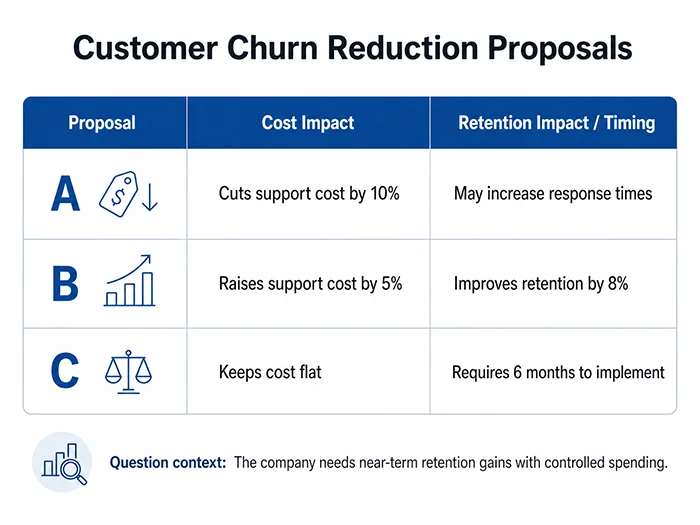
A team has three proposals for reducing customer churn
Proposal A cuts support costs by 10 percent but may increase response times
Proposal B raises support costs by 5 percent and improves retention by 8 percent
Proposal C keeps costs flat but requires six months to implement
Which option is strongest if the company needs near-term retention gains with controlled spending
A. Proposal A
B. Proposal B
C. Proposal C
D. There is not enough information
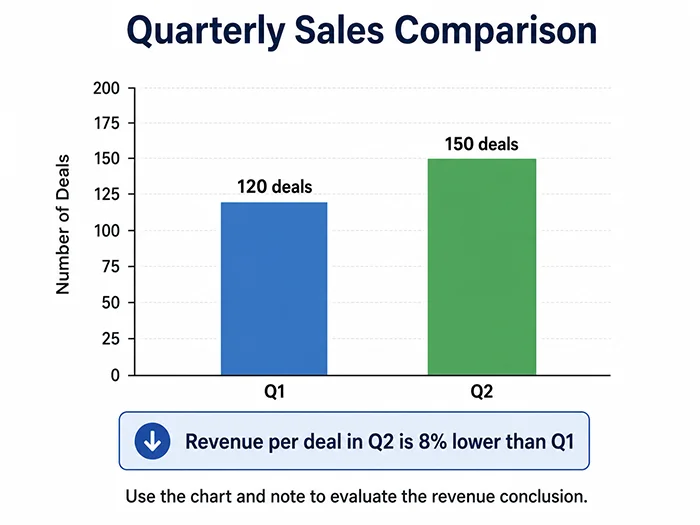
A sales unit closed 120 deals in Q1 and 150 deals in Q2. Revenue per deal fell by 8 percent in Q2. Which conclusion is most reasonable
A. Total revenue definitely increased
B. Total revenue definitely decreased
C. Deal volume increased, but total revenue needs more data
D. Revenue stayed flat
This type of item tests structured reasoning, not quick guessing.
| HBRI Skill Area | What You Need |
|---|---|
| Verbal reasoning | Read fast and catch the core claim |
| Quantitative reasoning | Compare values carefully before deciding |
| Graphic reasoning | Read charts without rushing key details |
| Decision logic | Pick the best supported answer, not the most dramatic one |
If you want to know how to pass the Hogan assessment stages without falling into obvious traps, focus on three things. First, know the role. Second, stay consistent. Third, avoid exaggerated patterns that make you look artificial.
Here is a smarter way to approach the test:
This is also where many people search for answers to the Hogan assessment test. The better approach is not memorizing ideal responses. It is about understanding what each scale may suggest to an employer and building a credible pattern rather than a forced one.
Many hiring teams and coaches do not look at one scale in isolation. They look at patterns. Hogan’s reporting products often combine HPI, HDS, and MVPI to show strengths, risks, values, and likely development themes in a single view. That means interpreting Hogan score reports requires context, not a single high or low score to panic over.
Here is the practical view:
This is why good Hogan testing preparation should help you see the whole profile, not just one isolated category.
Good employers use Hogan results to support behavioral competency mapping. That means they connect results to competencies like teamwork, judgment, leadership presence, adaptability, resilience, and decision quality. This is where predictive job performance becomes more relevant than raw personality labels.
For example, a sales leadership role may reward energy, resilience, social confidence, and measured competitiveness. A compliance-heavy role may place greater weight on prudence, stability, careful reasoning, and low risk of impulsiveness-related derailment. A creative strategy role may value curiosity and imagination, but still watch for overreach or inconsistency.
This is also why Hogan can support the identification of high-potential talent. Employers are not just asking if you can do the job now. They may also be asking how you will scale under bigger responsibility.

Industrial organizational psychologist with deep experience in psychometric reliability and validity reviews, leadership assessment design, and standardized personality profiling for hiring and development.

Assessment strategy consultant focused on normative scoring groups, role alignment, and practical support for candidates facing Hogan tests in leadership and commercial hiring.

Behavioral assessment advisor specializing in executive coaching assessment, score interpretation, and applied workplace personality analysis for promotion and selection contexts.
You do not need more generic advice. You need practice that respects how real employers use these tools. That is where MyHiringHub becomes useful. We help you move past random Hogan assessment sample questions and train with a cleaner sense of pattern, balance, and job fit. Our materials are built to support Hogan HPI sample test work, HDS interpretation, MVPI understanding, and HBRI logic in a way that feels practical, focused, and usable.
When you work with MyHiringHub, you get a stronger structure, better question exposure, and a clearer sense of how your profile may be read in a real selection process. That matters because Hogan tests are rarely used in isolation. They often sit inside broader talent decisions.
“I had no clue how subtle these assessments were. The practice helped me stop over-answering and start thinking about consistency.”

“The HBRI examples were the biggest help for me. I was fine on personality items, but the business reasoning side needed real timed practice.”
“I liked that the feedback was not robotic. It actually explained what a pattern could mean in a hiring context, and that changed how I approached the test.”
“The Hogan tests felt vague until I practiced. After that, I could see the structure much more clearly.”
“I used the material before a leadership hiring round. The HDS guidance helped me avoid obvious overstatements that could have made me look risky under pressure.”
“The score interpretation guidance was what sold me. I finally understood why one strong section does not automatically carry the whole result.”
A Free Hogan Assessment Practice Test is valuable when it gives you more than sample statements. It should help you understand how Hogan tests work together, how employers may read your pattern, and how your role target changes the meaning of a response. That is exactly the advantage you should aim for.
The right Hogan tests preparation can help you handle interpersonal sensitivity, stay consistent, improve HBRI timing, and make better judgment calls throughout the assessment. If you want better odds, start with practice that actually reflects how these tools are used in hiring.
Yes. Practice helps you see how the wording works, how repeated themes test consistency, and where candidates often overplay their answers. That can improve both confidence and control.
No. Hogan usually includes personality measures and may also include a reasoning measure, such as the HBRI. That is why your preparation should cover both behavioral questions and business logic.
Focus on these priorities:
For the personality sections, not in the traditional sense. But response patterns vary depending on the role, the employer, and the overall credibility of your profile.
Because it can reveal the dark side of personality under stress, employers use it to spot derailment risk, leadership friction, and patterns that can damage team performance if they go unmanaged.
Yes. The system is tied to workplace personality research, socioanalytic theory, and broader psychometric frameworks that support workplace assessment. That is a major reason organizations rely on it for selection and development.
A mix of strong practice and better judgment. The biggest gains usually come from:
Not at all. Hogan is used across different levels, including hiring, promotion, development, and coaching. The same assessment family can support entry-level selection, manager evaluation, and leadership planning.