Leadership Assessment Test Practice is not only useful for people applying for senior titles. It matters for supervisors, managers, directors, higher education leaders, healthcare leaders, executives, and internal promotion candidates who need to prove judgment before they enter the interview room.
A leadership assessment looks beneath your resume. It checks how you make decisions, how you respond under pressure, how you influence people, how you manage conflict, and how you balance business results with team trust. Strong experience can help, but experience alone does not always translate into strong test performance. The format can be unfamiliar. The wording can be subtle. The best answer is often the one that shows balanced leadership, not the one that sounds boldest.
MyHiringHub helps candidates prepare for these tests with realistic leadership scenarios, personality style questions, ranking drills, and answer explanations that focus on why a choice works. The goal is practical readiness, not memorized personality claims.
A leadership test is different because it often measures several things at once. One question may look like a conflict scenario, but it may also test accountability, coaching, emotional control, delegation, and risk awareness. A leadership exam may include situational judgment, personality items, business reasoning, role plays, simulations, 360-degree feedback, or written case analysis.
Many candidates lose ground because they answer as if every situation needs maximum authority. Real leadership assessment tests often reward measured action. The strongest response usually clarifies the problem, respects people, protects standards, and moves the business goal forward.
| Test format | What it usually checks | Strong candidate habit |
|---|---|---|
| Situational judgment | Decision quality and people’s judgment | Choose active but balanced responses |
| Personality inventory | Work style and leadership patterns | Stay honest and consistent |
| Ranking task | Priority setting and judgment | Identify the most effective and least effective actions first |
| Case simulation | Strategic thinking and communication | Use evidence before making a recommendation |
| Business reasoning | Numbers, logic, and commercial thinking | Separate facts, assumptions, and risks |
| 360 style review | Leadership reputation and impact | Know how others may describe your behavior |
Leadership Assessment Test Practice helps you read these layers instead of reacting only to the surface wording.
There are many leadership tests, and each one looks at leadership through a different lens. Some are built for hiring, some for promotion, and some for development. The right leadership exam prep starts with knowing which format you are likely to face.
| Assessment type | Common focus | Best preparation angle |
|---|---|---|
| Hogan Leadership Assessment | Reputation, derailers, values, reasoning | Understand work style and risk patterns |
| Korn Ferry Leadership Assessment | Potential, agility, traits, capacity | Practice leadership potential assessment items |
| Leadership Practices Inventory | Observable leadership behaviors | Rate behavior with realistic self-awareness |
| Caliper Assessment | Traits, motivation, role fit, problem solving | Prepare for forced-choice personality items |
| DDI Assessment | Judgment, readiness, simulations | Practice realistic management decisions |
| SHL OPQ | Workplace personality and preferences | Stay consistent across similar statements |
| Mercer Mettl Leadership Assessment | Strategic thinking and leadership style | Mix psychometric and case style practice |
| Select Assessment For Leader Development | Competencies for future leadership | Connect behaviors with success factors |
| Leadership Temperament Index | Leadership style and cognitive preference | Understand natural decision patterns |
| Leadership Alliance Assessment | Healthcare executive capability | Practice high-stakes leadership judgment |
| Indeed Management Skills Test | Practical management knowledge | Review people management basics |
| M2D Leadership Test | Personal, project, people, and strategy skills | Build a broad leadership competency map |
| MDA Leadership Assessment | Readiness for complex leadership roles | Practice scenario based judgment |
| John Maxwell Leadership Assessment | Influence and leadership growth | Reflect on influence and follow through |
| MBTI | Preferences in thinking and interaction | Avoid treating type as performance proof |
| DISC | Communication and behavioral style | Know your dominant workplace pattern |
| Birkman Method | Motivation, behavior, stress response | Prepare for needs and behavior differences |
| CliftonStrengths | Strength patterns and talent themes | Connect strengths to leadership impact |
| Amazon Leadership Tests | Work simulation and principles alignment | Practice decision making under culture rules |
| McQuaig Word Survey | Perceived behavior and natural behavior | Answer consistently across two lenses |
| Predictive Index Behavioral Assessment | Drives and workplace behavior | Understand pace, dominance, patience and formality |
| EQ-i Emotional Intelligence Assessment | Self-control, empathy, resilience | Practice emotion-based leadership judgment |
| 360 Degree Leadership Assessment | Feedback across colleagues and managers | Review how behavior appears to others |
This is why one generic leadership assessment questionnaire rarely covers every situation. A DDI-style item may ask you to choose the best response in a tense employee conversation. A Hogan style item may focus on recurring work behavior. A Korn Ferry style tool may look at learning agility and leadership potential. A university leadership test prep path may place more weight on academic administration, influence without direct authority, and stakeholder management.
Leadership tests are often described as personality-based, but that is only part of the picture. A leadership personality assessment may ask you to rate statements about your work habits. A leadership psychometric test may also include reasoning, motivation, decision style, and risk tendencies. A leadership competency assessment may focus on observable behaviors such as coaching, accountability, planning, influence, and change leadership.
In a leadership development assessment, the score may not be used only for hiring. It may guide coaching, promotion planning, or a leadership development tools package. In a managerial assessment, the employer may look for daily people management skills. In an executive leadership test, the focus can move into strategy, enterprise thinking, and stakeholder influence.
The leadership capability assessment usually asks a direct question: Can this person lead effectively at the level required? That answer may depend on communication, ethical judgment, emotional maturity, strategic thinking, and the ability to develop others.
For higher education roles, the language can change. Best test prep options for higher education leaders should include conflict management, academic governance, resource decisions, faculty relations, and student-centered judgment. The same applies to university leadership test prep, where authority is often shared, and influence matters as much as hierarchy.
A strong preparation plan should help you understand the lens behind the question. If the item is about conflict, do not only ask what stops the conflict fastest. Ask what protects trust, fairness, standards, and long-term team performance.
Leadership testing uses several answer formats. Each format requires a different habit.
Ranking questions ask you to compare all options. The fastest approach is to find the strongest and weakest choices first, then place the middle options. Some tests describe this as arranging from best to worst answers, and it can feel difficult because two responses may look partly right.
Rating questions ask how effective one response is. Do not compare too quickly. Judge the action on its own first, then compare it against the rest.
Forced choice personality questions ask which statement is most like you and which is least like you. These can feel uncomfortable because every statement may sound positive. The test is looking for priorities, not perfection.
Self-description items ask how often you behave in a certain way. Consistency matters, but exaggeration can weaken credibility. A leadership strengths test can be useful here because it helps you name your natural strengths without pretending every behavior is always true.
Case based questions provide background information, charts, email threads, or employee data. These are common in assessment management test formats because they check business judgment and management discipline.
In leadership testing, the strongest answers usually show four things: ownership, evidence-based thinking, clear communication, and respect for people. Leadership testing strategies should train you to look for those qualities before choosing an answer.
The following original sample questions show the kind of thinking often needed in leadership assessment test practice. Some use image placeholders because the visual element is part of the question.
Situational judgment
A high performing employee has started missing deadlines. Other team members are frustrated because they now have to cover unfinished work. You know the employee has recently been dealing with personal stress, but the missed deadlines are affecting client delivery.
What is the best first response?
A. Remove the employee from the project immediately and assign the work elsewhere
B. Speak privately with the employee, clarify expectations, ask what support is needed, and agree on a short recovery plan
C. Tell the team that everyone must be more understanding until the situation improves
D. Warn the employee in a public meeting so the rest of the team sees that standards matter
E. Ignore the issue because the employee has a strong record
Best answer
B
Explanation
This response balances empathy with accountability. It protects delivery, respects the employee, and creates a clear next step. Strong leadership evaluation does not reward harshness for its own sake. It rewards mature action.
Leadership personality statement
Rate the statement.
I make important decisions only after considering how the decision will affect people, deadlines, and business results.
A. Strongly disagree
B. Disagree
C. Neutral
D. Agree
E. Strongly agree
Best answer direction
Agree or strongly agree can be strong when it reflects your real behavior.
Explanation
This item connects to balanced judgment. A leadership personality test often checks patterns, not isolated heroic claims. The best answer should fit how you actually lead across repeated situations.
In the basket priority task
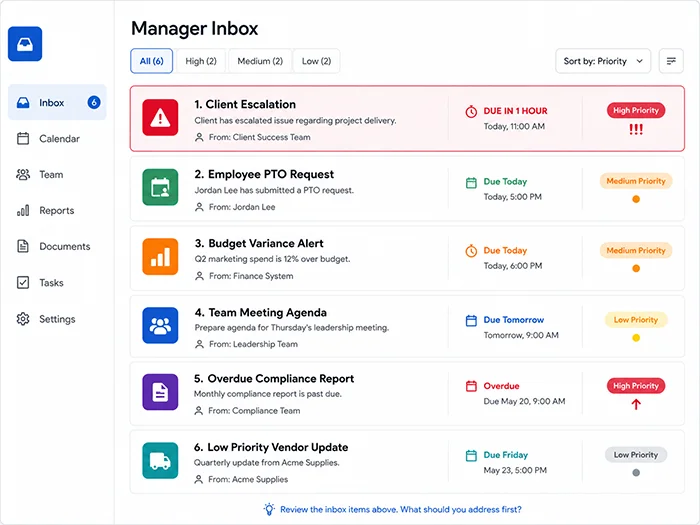
Which item should receive attention first?
A. Employee PTO request
B. Client escalation due in one hour
C. Team meeting agenda
D. Low priority vendor update
Correct answer
B. Client escalation due in one hour
Explanation
The client escalation is urgent, time sensitive, and connected to business risk. A leadership readiness assessment often checks your ability to prioritize based on consequence, not personal preference.
Team assessment scenario
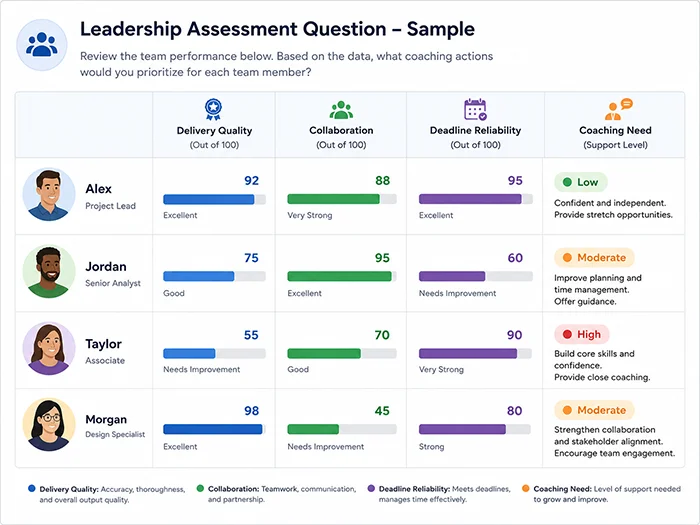
Which leadership action is most appropriate?
A. Give the same feedback plan to all team members
B. Focus only on the lowest performer and ignore the others
C. Create different coaching priorities based on each person’s pattern
D. Replace the lowest-scoring employee immediately
Correct answer
C
Explanation
A leadership team assessment should lead to targeted coaching. Different people may need different support. A strong leader reads the pattern before acting.
Executive judgment prompt
Your department can fund only one major initiative this quarter. One option improves customer retention. Another reduces internal cost. A third improves employee capacity but will take longer to show results.
What should you do first?
A. Choose the customer retention option because customers always matter most
B. Choose the cost reduction option because savings are easier to measure
C. Compare business impact, risk, urgency, and resource limits before making a recommendation
D. Let the most senior stakeholder decide without analysis
Correct answer
C
Explanation
Executive judgment requires structured thinking. The best response does not jump to the most attractive outcome. It compares impact, evidence, timing, and tradeoffs before recommending action.

Adrienne works with candidates preparing for leadership assessment tests, promotion panels, and behavioral leadership evaluations. Her specialty is helping candidates read what a scenario is really measuring before they choose a response.

Malcolm focuses on leadership psychometric test readiness, personality based inventories, and forced-choice answer patterns. He helps candidates stay honest while avoiding inconsistent or exaggerated profiles.

Tessa supports candidates preparing for leadership competency assessment formats, higher education leadership selection, and case-based management exercises. Her coaching connects evidence, stakeholder thinking, and practical leadership action.
Many candidates worry that practice will make them sound fake. Good preparation does the opposite. It helps you recognize effective leadership behavior so your answers become clearer and more consistent.
Start by building a leadership evidence bank. Write down real examples involving conflict, coaching, missed targets, pressure, change, ethical decisions, stakeholder disagreement, and team development. These examples help with interviews and also improve how you think during a leadership assessment test free practice session.
Next, identify your natural leadership pattern. Are you more direct, supportive, analytical, collaborative, or cautious? None of these is automatically wrong. The risk appears when one pattern becomes extreme. A very direct leader may ignore team buy-in. A very supportive leader may avoid hard conversations. A very analytical leader may delay action.
Then practice with realistic leadership tests. Use timed scenarios, personality items, and case prompts. Review each missed item by asking what competency was being measured. Was it delegation, conflict management, ethics, business judgment, resilience, influence, or coaching?
A free leadership assessment test PDF can help as a starting point, but it should not be the whole plan. Strong preparation needs answer explanations, realistic scenarios, and a review that connects choices to leadership competencies. MyHiringHub gives candidates a more practical way to train across multiple formats without reducing leadership to memorized lines. No matter if you are preparing for big five personality tests or any of these 22, we are here to assist you all the time.
Leadership assessments vary by provider, but many focus on a similar set of core skills. The wording changes, yet the underlying signals stay familiar.
| Leadership skill | What strong behavior looks like | Weak signal to avoid |
|---|---|---|
| Accountability | Owns problems and follows through | Blames others or hides issues |
| Coaching | Builds capability in others | Fixes everything alone |
| Decision quality | Uses evidence and context | Acts only on instinct |
| Influence | Gains commitment through clarity | Relies only on authority |
| Emotional control | Stays steady under pressure | Reacts defensively |
| Strategic thinking | Connects action with long term impact | Focuses only on immediate tasks |
| Integrity | Protects standards and trust | Bends rules for convenience |
| Change leadership | Guides people through uncertainty | Pushes change without context |
A leadership strengths test can help you identify where your natural habits are strongest. A leadership development assessment can show where you need more growth. A leadership capability assessment can connect both sides by showing how ready you are for the role level.
For an executive role, the test may focus on enterprise judgment. For a frontline supervisor, the same theme may appear as coaching, scheduling, and handling conflict. For an academic role, leadership potential assessment items may focus on shared governance, faculty relationships, and program outcomes.
The hardest leadership questions often include three responses that all sound professional. The difference is usually depth. One answer may solve the symptom. Another may solve the root cause. A third may solve the problem but damage trust. When choices look similar, use this order:
This method works across many leadership assessment tests because it reflects mature management behavior. It also helps in a leadership exam where the best answer is not always obvious.
For personality-based questions, do not chase the “perfect leader” profile. A believable leader has strengths, preferences, and development areas. Strong leadership assessment test practice helps you answer with consistency while still showing readiness for responsibility.
For ranking tasks, compare the purpose of each option. The best response is usually active, fair, evidence-based, and aligned with role expectations. The worst response is often avoidant, impulsive, unethical, or damaging to team trust.
Leadership preparation should match the level of responsibility. A new supervisor is tested differently from a vice president. A director is tested differently from a team lead. An executive is tested differently from an individual contributor entering a leadership pipeline.
| Role level | Likely assessment emphasis | Practice priority |
|---|---|---|
| Emerging leader | Potential, motivation, learning agility | Leadership potential assessment practice |
| Frontline manager | Coaching, accountability and conflict handling | Situational judgment and people scenarios |
| Department leader | Resource decisions and cross-team influence | Case based leadership testing |
| Executive | Strategy, risk, stakeholder alignment | Executive leadership test simulations |
| Higher education leader | Governance, faculty relations, student impact | University leadership test prep scenarios |
| Healthcare leader | Safety, pressure, ethics and team coordination | Leadership Alliance style judgment |
This is where an assessment management test can be useful. It forces you to make decisions with limited time, competing priorities, and incomplete information. That is closer to real leadership than a simple self-rating item.
A leadership competency assessment is especially important for candidates seeking promotion. Internal candidates can be judged more closely because the employer may already know their work history. The assessment then becomes a way to compare readiness with role expectations.
A leadership team assessment may also be used when organizations want to evaluate a full management group. In that setting, the result may support coaching, succession planning, or team development rather than only selection.
Leadership testing can be subtle. The answer that feels impressive is not always the answer that scores well.
One common trap is overcontrol. Taking charge can be good, but taking over every task can show weak delegation. Another trap is overempathy. Listening matters, but avoiding accountability can create bigger problems. A third trap is speed without evidence. Fast decisions look confident, but leadership judgment needs enough information to avoid preventable mistakes.
The fourth trap is inconsistency. A candidate may claim to value collaboration, then choose a response that ignores team input. They may claim to handle conflict calmly, then select a public confrontation. Many leadership personality tests are built to notice these patterns.
The fifth trap is missing the level of the role. A senior leader should not solve every small issue personally. A new manager should not pass every hard problem upward. The best answer fits the authority and responsibility of the position.
Leadership testing is not asking you to be perfect. It is asking if your choices match the leadership needs of the role.
Leadership Assessment Test Practice is structured preparation for leadership selection tools, including situational judgment questions, personality items, ranking tasks, case simulations, and management scenarios. It helps candidates understand what leadership behaviors are being measured and how to answer with better judgment.
A personality test usually looks at work style, preferences, motivation, and behavior patterns. A leadership assessment can include personality, but it may also measure decision quality, business reasoning, coaching, conflict management, readiness, and leadership potential.
Start with realistic workplace scenarios and practice choosing responses that balance people, standards, and business impact. Then review personality style items for consistency. Candidates should also prepare examples of coaching, conflict resolution, accountability, and change leadership because these themes often appear again during interviews.
They can help you understand the format, especially at the beginning. For serious selection, free drills are usually not enough because they may lack detailed explanations, ranking logic, provider-specific format practice, and role-level guidance.
Focus on the formats that appear across many providers:
Answer honestly, but think carefully. Avoid extreme claims that do not match your real behavior. Strong answers should reflect consistent patterns of accountability, communication, resilience, and sound judgment.
Practice can improve your familiarity with question types, reduce rushed answers, and help you avoid inconsistent response patterns. It should not be used to fake a personality profile. The best use of practice is to understand what the test is asking and respond with clear self-awareness.
Common options include Hogan, Korn Ferry, Caliper, DDI, SHL OPQ, DISC, MBTI, CliftonStrengths, Birkman, EQ-i, and 360 style leadership evaluation tools. Senior roles may also include case simulations, executive interviews, and role-specific assessment centers.