The Corrections Officer Practice Exam is more than a study step. It is a performance test for people who want to prove they can read carefully, apply policy correctly, stay alert to detail, and make sound decisions in a structured correctional setting. Written assessments for correctional roles are built to screen for judgment, discipline, accuracy, and mental control under pressure. If your goal is to move into a secure facility role, your written score can become one of the first major filters in the hiring process.
That is why strong preparation matters. You are not only reviewing facts. You are training how to think through rules, reports, timelines, incidents, grammar, and correctional judgment with the kind of clarity the role demands. A serious Corrections Officer Practice Exam should help you get sharper across question types, not just familiar with the page layout. When your preparation is built well, you begin to read instructions better, move through details faster, and make fewer careless errors.
For many applicants, the challenge is not one single topic. It is the range. You may face reading and report-writing tasks, procedural questions, numerical items, observation tasks, and behavioral scenarios in one broader hiring path. That is why your prep should match the full mental demand of the job. A rushed, generic approach usually leaves gaps. A targeted one helps you develop steadier performance where it counts.
A lot of candidates walk into a correctional written exam assuming the biggest challenge will be memorization or basic math. In reality, many struggle because the exam mixes multiple skills together. You may need to read a set of rules, apply them to a scenario, distinguish between close answer choices, and do it all without drifting off the exact wording. That combination is where many scores break down.
The test can feel difficult because it often blends reading precision with workplace judgment. You are not simply solving abstract logic problems. You are making decisions in a context where order, safety, policy, and observation all matter. That is what makes behavioral scenarios in correction officer tests and law enforcement situational judgment questions so important. A weak answer may not look obviously wrong at first, but it can still reveal poor judgment, unnecessary escalation, or weak procedural thinking.
The same thing happens with written material. Reading and report writing in correction exams are challenging because the wording matters. Candidates often know the general idea but miss a key phrase, timing detail, or inconsistency. That is why improving accuracy in correction officer tests becomes just as important as learning the topics themselves.
This is also why agencies rely on these assessments as a kind of custodial officer aptitude assessment, institutional security test, and offender management assessment test. The job depends on consistent thinking, not lucky guessing.
A proper study approach should not be built around one subject alone. It should cover the major skills that correctional written testing is likely to measure and help you improve how you move across them under time pressure.
Here is a practical breakdown:
| Skill Area | Why It Matters | Common Weakness |
|---|---|---|
| Rule Application | Helps you respond to procedures accurately | Rushing the wording |
| Report Reading | Important for identifying facts and conflicts | Missing one key detail |
| Written Communication | Matters for clarity and correctness | Choosing answers by instinct |
| Basic Math | Supports routine quantitative tasks | Slow calculation habits |
| Observation And Memory | Helps with recall and detail control | Overthinking easy items |
| Judgment And Response | Shows professional decision quality | Picking harsh or passive answers |
This is why serious correctional officer exam preparation online should include more than one type of drill. You want prison officer test practice questions, jail officer written exam prep, and realistic scenario work that helps you transition between mental tasks without losing control.
If your preparation includes detention officer aptitude test practice, correction officer recruitment test practice, and section-based review, your study starts becoming much more useful. Instead of just doing more questions, you begin building a performance system.
One of the most valuable areas to practice is rule application. These questions present a policy, schedule, list of standards, or written instructions and then ask you to apply them to a scenario. This can look simple, but many candidates lose points by reading the passage before understanding the question.
That is why one of the strongest practice methods for the correctional officer test work is to begin with the question. When you know what you are looking for, the written information becomes easier to process.
Facility Rule Set
At 08:20, Inmate K is found in the recreation yard. Records show that Inmate K was scheduled for medical transport at 08:15.
Which rule issue is most clearly shown?
A. Inmate K reported to the wrong interview area
B. Inmate K attended recreation during a scheduled movement
C. Officers are not allowed to move inmates after 08:15
D. Medical transport requires a legal visit first
Correct Answer
B. Inmate K attended recreation during a scheduled movement
Explanation
The rules say no inmate may attend recreation during a scheduled medical or legal movement. Inmate K had a medical transport assignment for 08:15, yet was found in recreation at 08:20. That is the direct violation shown by the facts. This is the kind of item that rewards exact reading. You do not need outside knowledge. You need to match the rule to the scenario without drifting into assumptions.
Questions like this are common in correctional officer written assessment prep, detention officer exam questions and solutions, and broader correctional officer hiring exam practice because they reflect the real need to follow policy correctly.
Another major written skill is processing reports, schedules, logs, and movement records. This type of item tests whether you can compare written data and notice what does not line up. It is one of the clearest ways to see how correction officer exam evaluation criteria work in practice.
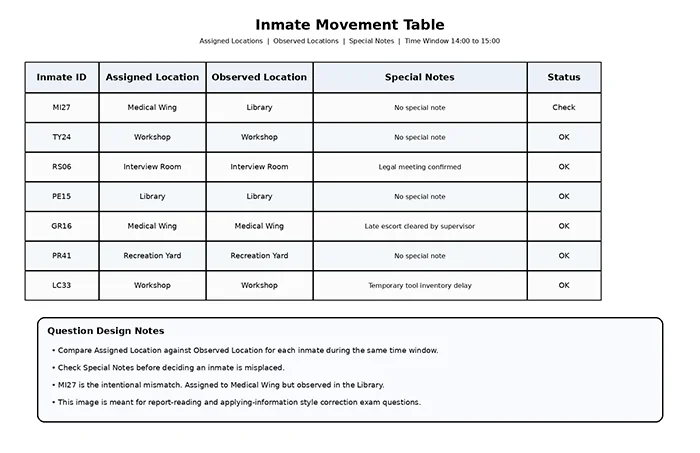
Use the movement chart and notes to answer the question.
Which observed area contains an inmate who is not where the schedule says they should be during the 14:00 to 15:00 period?
A. Library
B. Medical Wing
C. Workshop
D. Interview Room
Dependent on the image chart
Explanation
This type of question is less about knowledge and more about method. You compare the assigned location, observed location, and any notes that change the schedule. The right answer is the one where the inmate’s observed placement conflicts with the required location after all notes are accounted for. This is where solving scenario-based correction questions becomes practical. Strong candidates work carefully, row by row, instead of scanning the whole chart in panic.
This type of drill belongs in a serious correctional facility officer exam guide, detention officer written exam guide, and jail officer exam simulation questions set because it measures workplace accuracy directly.
Correctional roles require clear reading and strong written judgment. You may need to read memos, reports, witness statements, or policy summaries and answer questions that depend on the exact meaning. You may also face grammar, sentence order, spelling, or editing items where only one option creates the clearest professional statement.
That is why reading and report writing in correction exams deserve focused practice. If your reading pace is fine but your comprehension is careless, you can still lose a large number of points.
Read the statement below and choose the best revision.
Original sentence
The officer reviewed the housing log and noted that several entries were incomplete, which made the timeline difficult to verify.
A. The officer reviewed the housing log and noted that several entries were incomplete, which made the timeline difficult to verify.
B. The officer reviewed the housing log and noted that several entries were incomplete, which made the timeline difficult to verify.
C. The officer reviewing the housing log noted several entries were incomplete, which made the timeline difficult to verify.
D. No changes are necessary.
Correct Answer
A
Explanation
The subject “entries” is plural, so the verb must be “were.” The revised sentence also uses punctuation correctly and keeps the meaning professional and clear. This question is not hard because of vocabulary. It is hard because weak options often look close enough to pass under time pressure. Written communication work in a correctional setting demands exact wording, not approximate wording.
These items fit naturally into correction officer employment test prep, correctional officer exam drills, and jail officer cognitive test preparation because written clarity is part of the role.
Arrange the statements into the most logical order.
The unit search began at 10:00 after all inmates were moved to the dining hall.
Contraband was later discovered behind a loose vent cover in Cell 14.
The supervising officer documented the search findings before the shift ended.
Staff first confirmed that the housing unit had been secured.
A. 4 1 2 3
B. 1 4 2 3
C. 2 4 1 3
D. 4 2 1 3
Correct Answer
A
Explanation
The unit would first need to be secured, then the search could begin, then the contraband could be discovered, and finally, the findings would be documented. Paragraph order questions are really logic questions wearing a writing mask. They test whether you can recognize a natural operational sequence. That skill matters in both reporting and structured reading.
Most correctional written exams do not require advanced math, but they do expect accuracy and steady reasoning under time pressure. That is why the correctional officer skill assessment test work should include fast arithmetic, percentages, fractions, and simple conversions or count-based problems.
An officer inventory report shows the following counts for confiscated prohibited items during the week:
How many items were recorded in total?
A. 55
B. 61
C. 65
D. 71
Correct Answer
C. 65
Explanation
Add the daily totals carefully: 14 plus 11 equals 25, plus 18 equals 43, plus 9 equals 52, plus 13 equals 65. These questions become harder when candidates rush because the numbers look harmless. A steady method matters more than speed alone. For many applicants, math errors are not concept errors. They are attention errors.
A supply unit issued 240 gloves. If 25% were used during intake operations, how many gloves were used?
A. 40
B. 50
C. 60
D. 75
Correct Answer
C. 60
Explanation
Twenty-five percent is one quarter. One quarter of 240 is 60. This is the kind of shortcut that helps when calculators are not available. Good correctional officer qualification exam prep includes learning clean mental methods that save time without damaging accuracy.
These items fit well inside prison officer entrance test questions, prison officer job test practice, and correctional officer evaluation exam prep because they reflect the need for reliable calculation under ordinary work pressure.
A strong correctional applicant must be able to detect when written statements do not line up. This is one of the most job-relevant forms of reasoning on the exam because it mirrors incident review, witness comparison, and documentation work inside a secure environment.
Witness A stated: “Inmate R pushed Inmate J first. After that, Inmate J yelled but did not strike back.”
Witness B stated: “I saw Inmate J swing first, then both inmates started pushing each other.”
Based only on the statements, what issue most clearly requires further review?
A. Which inmate was in the hallway
B. Who initiated physical contact
C. Whether either inmate raised their voice
D. Whether staff responded too slowly
Correct Answer
B
Explanation
The clear conflict is about who started the physical incident. Witness A says Inmate R pushed first. Witness B says Inmate J swung first. That contradiction matters directly to the event. The other answer choices either are not disputed or are not supported by enough information. This is how a correctional officer scenario-based test often measures report comparison. The key is to look for the difference that would change the understanding of the incident.
These questions fit well inside the correctional officer competency test, custodial judgment test, and institutional behavior assessment preparation because they measure structured observation and report-based logic.
This section often feels easy until the timer and the details start working against you. Some tests ask you to study a written passage, sign, roster, or picture and then answer questions after it is removed. Others ask you to compare images or spot differences. The hardest part is not memory alone. It is staying methodical.
Read and memorize the following text.
Officer Maria Ellison responded to Unit C at 6:45 p.m. after a report of an inmate's collapse near the laundry station. The inmate involved was Daniel Mercer, ID 47C-119. A search of the immediate area located a small paper packet under the bench near the supply door. Sergeant Nolan Pierce secured the area while medical staff transported Mercer to the infirmary. The packet was later logged into evidence by Officer Ellison.
Question
Who secured the area after the incident?
A. Officer Maria Ellison
B. Daniel Mercer
C. Sergeant Nolan Pierce
D. Medical staff
Correct Answer
C. Sergeant Nolan Pierce
Explanation
The passage states clearly that Sergeant Nolan Pierce secured the area. Memory questions reward clean capture of names, times, roles, and sequence. A strong method is to mentally group details by category instead of trying to remember them as one long stream. That is one of the best ways to improve recall without overloading your attention.
Compare the two yard-scene images and identify how many differences appear.
A. 1
B. 2
C. 3
D. 4
Correct Answer
Dependent on the image
Explanation
This type of question measures accuracy, not imagination. The right way to approach it is systematically. Compare top to bottom and left to right. Avoid jumping between parts of the image randomly. These tasks are common in prison guard test preparation, detention officer aptitude test practice, and correctional officer exam readiness tests because they mirror the need for controlled observation under pressure.
Situational judgment questions are some of the most revealing parts of correctional written testing. They ask what you would most likely do or least likely do in a work situation. There may not be one mathematically perfect answer, but there are still clearly stronger and weaker responses.
That is why behavioral scenarios in correction officer tests and correctional decision-making scenarios deserve repeated practice. These items often reflect the values of professional conduct, proportional response, safety, documentation, chain of command, and calm intervention.
What is the most appropriate first response?
A. Immediately order the inmate into restraints
B. Ignore the behavior unless it becomes physical
C. Give a calm verbal directive and create space while monitoring the situation
D. Challenge the inmate in front of the group to establish authority
Correct Answer
C
Explanation
A calm verbal directive paired with observation and controlled spacing is the most proportionate first step. It addresses the behavior without escalating unnecessarily. Restraints may become appropriate later if risk rises, but they are not the best first response to the facts given. Ignoring the situation is too passive, and public confrontation can worsen tension. This is what solving scenario-based correction questions should train you to do: choose steady, professional action instead of overreaction or avoidance.
What is the least appropriate response?
A. Continue the search and address the behavior privately with the officer afterward
B. Join the joking so the officer does not feel singled out
C. Keep the search focused and avoid adding to the conduct issue.
D. Report the matter through the proper channel if the behavior continues
Correct Answer
B
Explanation
Joining the behavior makes the professionalism issue worse and signals poor judgment. The stronger responses keep order and preserve dignity while leaving room for correction through the proper process. Situational judgment is not about dramatic heroics. It is about controlled conduct that protects institutional professionalism.
A high-quality study plan should build consistency, not panic. If your test date is coming, do not try to master everything in one day. Use a structured sequence.
That kind of pacing helps with preparation strategy for jail officer exam, practice methods for correctional officer test, and broader correction officer employment test prep because it trains both skill and rhythm.

Renee focuses on written public-safety testing, report analysis, and judgment under pressure. She helps candidates improve how they read policy language, compare written facts, and handle structured scenario questions.

Gavin works with candidates who need stronger grammar, paragraph logic, report clarity, and written-response control in correctional and law-enforcement exam settings.

Alina focuses on behavioral reasoning, observation, memory, and correctional judgment. Her work helps candidates improve response quality on situational items and incident-comparison questions.
“I needed something that felt close to real correctional hiring pressure. The rules and report questions were the biggest help. I was missing details before, and that changed fast.”

“The written communication and scenario judgment sections were what I feared most. After practicing with structured explanations, I felt much calmer and more deliberate.”
“I had looked at random public safety questions before, but they were not enough. This gave me a more useful way to train for the full written exam.”
“The memory drills and conflict-comparison questions really stood out. They felt practical, not generic. I walked into testing with much better control.”
A lot of prep options give you question volume, but not enough structure. That is a problem for a correctional written exam because the challenge is not just content. It is switching efficiently between policy, math, writing, memory, and judgment without losing focus.
That is where MyHiringHub helps. Our approach is built to strengthen the exact habits these exams reward: careful reading, report comparison, clean written reasoning, steady arithmetic, and proportionate situational judgment. Instead of giving you one narrow skill in isolation, we help you build exam readiness across the areas that matter together.
That matters because this is not only a written hurdle. It is part of a broader detention facility hiring evaluation, prison service entrance assessment, and institutional behavior assessment process. Better training gives you a better chance to perform with clarity when the assessment begins.
A strong Corrections Officer Practice Exam should not leave you guessing about your own weaknesses. It should show you exactly where you lose accuracy, where timing affects judgment, and which skills need more repetition. That is how your preparation becomes useful.
If your goal is a correctional career, treat the written exam like the serious gateway it is. Strong work on rules, reports, memory, writing, math, and judgment can change how you perform and how your application moves forward. When your study becomes structured, your score becomes more stable. When your method becomes sharper, your confidence becomes more real.
Use this process to build consistency, not just familiarity. That is what helps you show up ready when your hiring date arrives.
A strong written prep set often includes:
Focus on the highest-value skills first. Spend more time on rule reading, report comparison, grammar, and scenario judgment than on random memorization alone.
No. Structure, timing, scoring, and even question style can vary by agency or jurisdiction, which is why general skill-building is so valuable.
Start with the question, then go to the report. That keeps you focused on the exact detail being tested. For many candidates, report questions become easier once they stop scanning everything at once and start comparing only the relevant rows, times, or names.
Not always in the same way math questions do, but they still reward professional, proportional, and safety-minded responses. Strong answers usually reflect calm control, proper escalation, and respect for procedure.