Korn Ferry Practice Tests give candidates a practical way to prepare for assessments that can shape hiring, promotion, and leadership decisions. They can examine reasoning speed, leadership judgement, work style, motivation, numerical analysis, verbal accuracy, logical pattern recognition, and attention to detail.
A candidate may face a Korn Ferry leadership assessment, a KF4D assessment, a Talent Q style ability test, or a blended hiring screen that combines several sections. Scattered practice is not enough. The better path is structured preparation that shows how each section works and where mistakes usually begin.
MyHiringHub supports candidates who want to train with discipline before the real assessment link arrives. Korn Ferry Practice Tests help you navigate the format with greater control, stronger review habits, and a clearer understanding of the employer evaluation process behind the screen.
Leadership sections are not simple personality quizzes. They are designed to expose priorities. Many items force you to choose among positive traits, which means every option may sound good. The challenge is deciding which quality matters most for the role.
The Korn Ferry Leadership Potential Assessment often looks beyond current performance. It considers signs of growth, learning, influence, resilience, and future leadership capacity. KF4D four dimensions of leadership prep is more immediate because the employer may be checking readiness for a specific leadership role.
The four dimensions of leadership and talent include how you behave, what motivates you, the experience you bring, and the traits that help you handle complexity. A good Korn Ferry 4D assessment guide should therefore help you think in role terms, not personal preference alone.
A sales leadership role may reward influence, commercial drive, and customer focus. An operations leadership role may reward structure, accountability, and reliable execution. A people management role may require empathy, direction-setting, and conflict-handling. The strongest candidate reads the role carefully before answering forced choice items.
Korn Ferry assessments are often used when an employer wants a deeper view of candidate potential. A resume may show experience, but an assessment can show how a person reasons, behaves, prioritizes, and reacts when a decision is not obvious.
The structure can differ by employer. One candidate may complete leadership based exercises. Another may complete Talent Q assessments with numerical, verbal, logical, and checking tasks. A senior candidate may face Korn Ferry executive assessment modules tied to leadership readiness. Some candidates also encounter a Korn Ferry CRA-style test for role-specific evaluation.
| Assessment area | What it may examine | Best practice focus |
|---|---|---|
| Leadership assessment | Drivers, traits, competencies, experience | Role fit and leadership judgement |
| KF4D framework | Four dimensions of leadership and talent | Balanced work style evidence |
| Talent Q ability tests | Numerical, verbal, logical and checking ability | Timing and accuracy |
| Work style profile | Motivation, behavior, identity at work | Consistent self-presentation |
| Situational judgement | Workplace choices and tradeoffs | Practical decision quality |
This is where Korn Ferry assessment scoring becomes important. The result is not only about correct answers in cognitive tasks. It may also compare your profile with a role model, leadership expectations, role competency requirements, and organizational leadership metrics.
Talent Q assessments usually feel different because they are more technical and time-sensitive. The platform may include numerical, verbal, and logical reasoning, as well as checking. These sections can function as a job-application aptitude exam, a cognitive-ability screening tool, and an analytical-thinking test in a single sitting.
Adaptive reasoning test strategies are useful because difficulty can shift as performance changes. If a section becomes harder, that does not mean you are failing. It may mean the test is finding your ability level. The mistake is letting one hard item affect the next question.
A Q Talent test preparation routine should include short, timed drills, careful answer review, and realistic question sets. Talent Q is not won by reading explanations only. You need practice that trains fast reading, clean calculations, pattern tracking, and exact comparison.
| Talent Q area | Common challenge | Better habit |
|---|---|---|
| Numerical | Data tables with tight timing | Identify the needed figure first |
| Verbal | Passage claims and inference traps | Answer only what the text supports |
| Logical | Pattern changes across rows and columns | Track one rule at a time |
| Checking | Similar codes with small differences | Compare in fixed chunks |
Good Korn Ferry practice tests should treat the leadership and ability sections differently. A forced choice leadership item needs reflection. A checking item needs speed and precision. A numerical item needs a clean setup. A logical item needs pattern discipline.
The best preparation does not start with a large volume of questions. It starts with useful coverage. A strong set of premium Korn Ferry study materials should include explanations, role based thinking, and question formats that reflect the actual assessment family.
Some candidates begin with the Korn Ferry assessment practice, which includes free resources to learn the format. After that, deeper preparation may require professional Korn Ferry test coaching, targeted answer review, and repeated simulations that train both cognitive and leadership sections.
Helpful preparation can include a self-service assessment portal, a professional personality inventory review, work-style profiling, and a Korn Ferry talent hub style dashboard that tracks weak areas. These tools are most useful when they push candidates to improve the reason behind an answer, not just memorize a key.
Korn Ferry numerical test answers PDF files can help with review, but they should not be the entire plan. A PDF does not teach timing unless you practice under real limits. Korn Ferry logical test answers PDF resources can support pattern review, but you still need live practice to build speed.
The strongest preparation uses three layers. First, learn the section. Second, practice the skill. Third, review the mistake pattern. That is how Korn Ferry Practice Tests become training instead of passive reading.
The examples below are original study items. Some include image placeholders because the visual part is required for the question.
You are preparing for a team lead role. Select the two qualities that should be treated as the highest priority for the position.
A. Enjoys working independently
B. Gives clear direction during uncertainty
C. Avoids difficult conversations
D. Builds trust with team members
E. Prefers familiar tasks
Best answer
B and D
Explanation
A leadership role requires direction and trust. Independent work can be valuable, but it is not as strong as guiding others and building confidence across a team. This style reflects behavioral competency modeling because the answer depends on the role and the behaviors that make the role effective.
A regional team reports the following monthly sales.
| Month | Units sold | Revenue |
|---|---|---|
| January | 420 | 33600 |
| February | 500 | 42500 |
| March | 460 | 39100 |
| April | 540 | 48600 |
Correct answer
D. April
Explanation
Divide revenue by units. January equals 80, February equals 85, March equals 85, and April equals 90. April has the highest revenue per unit. This is the kind of item where a calm method beats guessing. Numerical questions often look busy because the table has more information than you need.
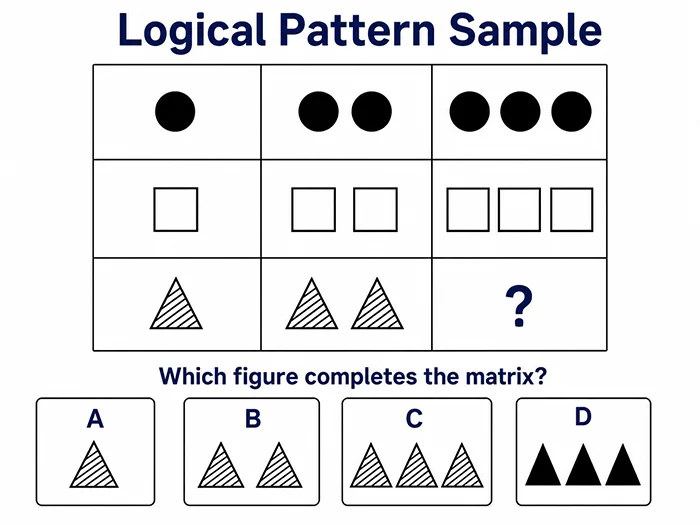
Which figure completes the matrix?
A. One striped triangle
B. Two striped triangles
C. Three striped triangles
D. Three black triangles
Correct answer
C. Three striped triangles
Explanation
Each row keeps the same shape type and increments the count by 1. The final cell must continue the third row with three striped triangles. This item rewards rule tracking, not visual guessing.
Compare each pair and mark whether they are the same or different.
| Row | Code one | Code two |
|---|---|---|
| 1 | K7429 118C 62Q | K7429 118C 62Q |
| 2 | M5108 77AL 409 | M5108 77LA 409 |
| 3 | R6630 22PX 918 | R6630 22PX 918 |
| 4 | V9041 13BT 771 | V9041 13B T771 |
Which rows are different?
A. Row 1 only
B. Rows 2 and 4
C. Rows 1 and 3
D. Rows 2 and 3
Correct answer
B. Rows 2 and 4
Explanation
Row 2 switches AL into LA. Row 4 changes spacing and grouping around 13BT. Checking questions reward a fixed comparison system. Read in small blocks and do not rely on a quick visual scan.
Read the passage.
A company introduced a mentoring program for new managers. After six months, participants reported better decision clarity and stronger communication with senior leaders. The company has not yet measured long-term retention.
Which statement is supported by the passage?
A. The program reduced turnover
B. Participants reported better decision clarity
C. Senior leaders completed the same program
D. The program failed to improve communication
Correct answer
B. Participants reported better decision clarity
Explanation
The passage directly states that participants reported better decision clarity. It does not confirm retention results or senior leader participation. Verbal reasoning rewards evidence control.
You manage a project with two high performers who disagree about priorities. One wants more client feedback before launch. The other wants to meet the deadline with the current version.
What is the best first action?
A. Pick the deadline-focused option because speed always matters
B. Ask both to present risk, value, and timing impact before deciding
C. Delay the project without speaking to the client
D. Remove both employees from the decision
Best answer
B
Explanation
The strongest action collects relevant information before making a choice. It respects both viewpoints and keeps the decision tied to project value. This reflects the kind of professional judgement that can appear in a recruitment screening test.
Reviewing a leadership item is not the same as reviewing a numerical item. Treating every mistake the same way leads to weak progress. Better review is section specific.
For leadership questions, ask which role the signal sends. Does it show influence, accountability, learning agility, collaboration, or strategic judgement? If the answer sounds positive but does not fit the role, it may still be weak.
For numerical questions, ask where time was lost. Did you choose the wrong figure, calculate the wrong ratio, or read the table too quickly? A correct method with slow execution needs timing practice.
For logical questions, identify the rule you missed. Count, direction, color, rotation, and position changes should be reviewed separately.
For checking questions, study your scan behavior. Compare chunks in a fixed order instead of judging whole codes at once.
For personality and work style items, check for consistency. A professional personality inventory can reveal contradictions when a candidate tries to sound ideal in every direction.
The KF candidate experience is usually designed to feel structured, efficient, and revealing. Employers want more than a pass-or-fail result. They want psychometric performance metrics that enable fairer comparisons of candidates across roles, teams, and leadership levels.
A candidate may start with an email invitation, complete a self-paced assessment, undergo cognitive ability screening and then move into interviews or feedback conversations. Each stage gives the employer more information.
Leadership agility testing is especially important in senior and high-potential hiring because it can show how a person adapts, motivates others, handles ambiguity, and learns in complex situations. Organizational leadership metrics may also connect assessment outcomes with future talent decisions, so trying to game every answer can backfire.
MyHiringHub helps candidates practice without turning answers into a fake script. The goal is a stronger understanding of section logic, more accurate self presentation, and better control over timed reasoning tasks.
A useful sequence begins with exposure, moves into correction and then finishes with mixed practice. That structure keeps study time focused without making every session feel the same.

Maren works on leadership assessment preparation for promotion and senior hiring candidates. Her approach connects Korn Ferry 4D, role priorities, and credible leadership judgment.

Graham specializes in numerical, logical, and checking sections. He helps candidates improve calculation setup, pattern recognition, and fixed scanning systems.

Vivian supports candidates preparing for leadership interviews after assessment stages. She connects assessment behavior with examples that show influence and decision quality.
“I was fine with verbal questions, but the logical patterns kept slowing me down. The explanations helped me name the rule before checking the options.”

“The leadership section surprised me. Every option sounded positive, so I needed a better way to think about role fit. The guidance helped me answer with consistency.”
“I used a free starter set first, then moved into mixed practice. The checking questions were the biggest improvement because I finally had a repeatable scan method.”
“The Talent Q practice felt useful because it separated numerical, verbal, logical, and checking work. I could see where I was wasting time.”
“I was preparing for a senior manager role and needed more than basic aptitude questions. The leadership material helped me think about drivers, traits, and experience.”
“The sample questions were clear, and the review process was practical. I liked that it did not just give answers. It showed how to read the question with the role in mind.”
A free practice set can help with format awareness, but competitive or senior roles often need more detailed review. Deeper support becomes useful when you run out of time, miss small checking differences, choose leadership answers that conflict, or struggle to explain why one option is stronger than another.
Korn Ferry assessment practice free materials can expose those weak points. Premium study tools and guided feedback can then help repair them through repeated, reviewed practice rather than surface familiarity.
The final stage should be calm and deliberate. Do not collect random new resources at the last moment. Revisit the sections that pose the greatest score risk and ensure your process is clear.
For numerical tasks, confirm your method for ratios, averages, percentage change, and table comparisons. For logical tasks, practice count, position, rotation, and sequence rules. For checking, use the same scan order every time. For leadership tasks, review the role profile and think about the behaviors that matter most.
Korn Ferry Practice Tests work best when they help you build repeatable habits. A strong candidate shows clear reasoning, consistent work style, credible motivation, and useful judgment. That is the practical purpose of the Korn Ferry practice tests.
Korn Ferry Practice Tests are study tools that help candidates practice for leadership assessments, Talent Q-style ability tests, logical reasoning, numerical reasoning, verbal reasoning, checking, and work-style questions before an employer assessment.
Talent Q ability tests are commonly connected with Korn Ferry hiring screens. They usually focus on numerical, verbal, logical, and checking ability, while leadership assessments may focus on traits, drivers, competencies, and experience.
Adaptive testing means difficulty may change based on your responses. A good practice routine should include:
The 4D model is often linked to readiness for a role by examining leadership dimensions and work-style fit. The Korn Ferry leadership potential assessment is more closely tied to future leadership capacity, growth signals, learning ability, and long-term potential. Both require thoughtful answers, not generic positive choices.
Free practice can help you see the format and find weak sections. It may not be enough when the role is highly competitive, the assessment includes multiple sections, or you need a detailed review of leadership tradeoffs and timed reasoning.
Use answer PDFs as review tools, not as your only preparation. A Korn Ferry numerical test answers PDF or a Korn Ferry logical test answers PDF can explain solutions, but you still need timed practice to build pace and accuracy.
Forced choice formats make candidates prioritize among positive qualities. This gives the employer a clearer view of drivers, traits, and work preferences because the candidate cannot simply agree with every attractive statement.
Keep the final day focused.