The Pymetrics assessment does not feel like a normal test. You are not reading long questions, picking tidy answer choices, or leaning on memorized formulas. Instead, you move through an interactive game-based assessment that tracks how you respond under pressure, how long you pause, how quickly you adapt, and how consistent your judgment remains when the rules shift.
That is why Free Pymetrics Games Practice matters more than people think. Good practice does not just show you what each game looks like. It helps you spot your habits before the real assessment starts judging them. You begin to see where you rush, where you overcorrect, where you take careless risks, and where your focus breaks down after a few repetitive rounds.
Pymetrics is built around neuroscientific behavioral tracking, not traditional right-or-wrong testing. That means your behavior matters at a much smaller level than many candidates expect. Tiny choices shape the final picture. One careless stretch in a reaction task, one overly aggressive pattern in a risk game, or one inconsistent fairness decision can shift how your profile is read. That is exactly why going in cold is a weak plan.
At MyHiringHub, we focus on giving you practice that feels purposeful. You are not here to click through random drills and hope for the best. You are here to sharpen judgment, settle nerves, and build a repeatable approach that holds up when the Pymetrics game assessment starts moving quickly.
Most candidates make one major mistake. They assume the games are easy because the instructions look easy. That is the trap. What you actually need is:
Some games reward restraint. Some reward controlled boldness. Some reward patience before action. Others reward sharp adaptation after a mistake. When you understand that difference, your practice immediately becomes smarter.
A weak prep routine turns every game into random clicking. A smart routine turns every round into a useful signal.
Pymetrics is not trying to test textbook knowledge. It is trying to read behavior. That is why the system is often described in terms of concepts such as predictive behavioral analytics and cognitive trait measurement. The games are designed to capture how you think, how you adjust, how you regulate impulses, and how your decisions hold together across different kinds of pressure.
That is also why candidates hear phrases such as “algorithmic bias-free testing.” The appeal is obvious. Hiring teams want a more structured signal than gut instinct, and candidates want a process that does not lean entirely on pedigree, polish, or resume branding. The games try to add behavioral evidence to the picture. That does not mean you should treat the assessment like magic. It means you should understand what kind of signal it is trying to collect. Across the full set, you will see tasks that feel like:
Each task looks simple on the surface. The deeper layer is the pattern of your behavior. Speed, hesitation, consistency, learning, restraint, and recovery all matter.
There is a big difference between hearing about the games and actually playing them. Reading about a stop task does not prepare you for the irritation of repeated signals. Understanding a risk task in theory does not prepare you for the feeling of losing accumulated gains in the moment. Seeing a sample emotion question does not fully prepare you for the subtle differences in expression when the screen is live and time feels tight.
That is where Pymetrics’ free online, game practice becomes valuable. It gives you room to make mistakes before those mistakes become part of your assessment profile. You get to notice the difference between being calm and being passive. You get to see how easy it is to chase a pattern that is not really there. You get to learn that good performance is rarely about extreme behavior. It is usually about measured behavior.
A strong Pymetrics practice test routine also helps with something candidates underestimate all the time, stamina. A lot of the games are short, but the total sequence asks you to switch gears again and again. Risk. Attention. Fairness. Memory. Emotion. Planning. Fast inhibition. That constant switching can wear you down if your practice has been too shallow.
Practice does not turn you into somebody else. It helps you show your best version more consistently.
Below is a practical overview of the games most candidates prepare for.
| Game | What It Tests Most | What Strong Candidates Usually Do |
|---|---|---|
| Balloon | Risk judgment and adaptation | They test early, learn the color patterns, then moderate risk instead of chasing every gain |
| Stop | Impulse control and sustained attention | They stay rhythmic without getting trapped by the rhythm |
| Arrows | Rule switching and focus | They lock in the rule fast and recover quickly after errors |
| Tower | Planning and foresight | They pause briefly, visualize moves, then act efficiently |
| Money Exchange 1 | Trust and social risk | They make a balanced decision that fits the role context |
| Money Exchange 2 | Generosity and fairness | They stay consistent and avoid extreme swings |
| Easy or Hard | Effort allocation and judgment | They match effort to reward probability, not ego |
| Keypress | Response control and processing speed | They avoid jumping early and stay clean through the finish |
| Cards | Pattern learning and risk control | They test options, watch outcomes, and shift once evidence builds |
| Lengths | Visual attention and motivation | They use a stable visual anchor and do not get distracted by rewards |
| Digits Memory | Working memory | They use chunking or verbal repetition with discipline |
| Faces | Emotion recognition and context reading | They read the expression carefully and do not overreact to one clue |
If you are wondering how to pass Pymetrics games, the answer is not to invent a personality. The answer is to become more intentional.
You do not want to look chaotic in the risk tasks, detached in the fairness tasks, careless in the focus tasks, or emotionally blunt in the face-reading task. At the same time, you also do not want to push every trait to an extreme. Hyper-cautious behavior can look rigid. Excessive generosity can look poorly bounded. Overdeliberation can look slow. Constant aggression can look impulsive.
A better strategy is built on four principles:
Know the job context: A front-office finance role, a consulting internship, an operations role, a product role, or a people-facing leadership role will not all reward the same behavioral pattern.
Stay internally consistent: If you act deeply risk-averse in one section and wildly aggressive in another without a clear reason, your profile becomes harder to read positively.
Let adaptation show up: Some of the strongest signals come from how you learn after an outcome. Good candidates do not keep repeating the same bad choice after new evidence appears.
Control your emotional tempo: These are games, but they are not casual. Frustration, overexcitement, and panic all show up in behavior.
That is why a high-quality prep routine is not about tricks. It is about self-management.
A lot of candidates worry about the company behind the assessment, and that instinct is not wrong. Role context matters.
If you are preparing for Blackstone Pymetrics practice, your strongest approach is usually disciplined judgment, pattern awareness, and measured risk. If your process includes a Sage Pymetrics assessment, you still want consistency and sharp thinking. Still, the emphasis may feel more balanced toward learning, focus, and composure rather than dramatic risk-taking.
The practical lesson is simple. Do not walk into every assessment trying to look like the same candidate. You want to stay authentic, but you also want to understand the behavioral style the role is likely to reward. A sales-heavy role and an analytical control-heavy role do not reward the same decision profile.
These are the moments where confidence drops, and patterns break. Certain Pymetrics games feel simple at first, then quickly expose hesitation, overreaction, or poor control. The pressure does not come from difficulty alone, but from how fast your decisions reveal habits. Candidates who rely on instinct without structure tend to swing between extremes. One round feels easy, the next feels chaotic. The key difference is awareness. Strong performers recognize what each game is testing and adjust early. Instead of reacting emotionally, they stay measured, consistent, and deliberate even when outcomes start to feel unpredictable.
The Pymetrics balloon game is often the first place where candidates expose a weak relationship with risk. On paper, it looks harmless. In practice, it pressures you into deciding how far you want to go before banking your gains. The balloon pumping game is not only about courage. It is about emotional regulation after wins and losses.
A strong Pymetrics balloon game strategy starts with observation. Early rounds are useful for testing, not for chasing maximum return. You want to identify how each balloon color behaves over time, then shift into more informed pumping behavior. Candidates usually get into trouble when they become greedy after one lucky streak or overly defensive after one ugly burst.
What strong performance tends to look like:
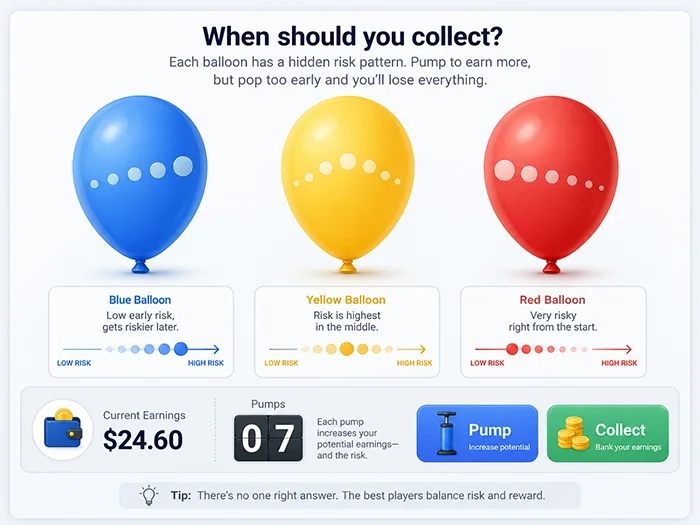
The Pymetrics money exchange game feels social, but it is still a decision task. It asks what you do with trust, fairness, and generosity when resources are limited, and outcomes are not always reciprocal.
Candidates often miss the deeper issue here. This is not a morality contest. It is a judgment test. Extreme selfishness can look cold. Extreme generosity can look unrealistic. What usually stands out best is a balanced choice that feels deliberate, defensible, and consistent with how you behave later in the assessment.
When you practice this game, pay attention to two questions:
If your action says one thing and your fairness judgment says another, that inconsistency can weaken the signal you send.
The card game and the easy-or-hard task both pressure your judgment more quietly. One asks you to detect patterns and adjust deck choices. The other asks how you allocate effort under changing reward conditions.
These are not showy tasks, but they matter. Employers want to see that you are not just energetic. They want to see that you can direct effort where it makes sense. Candidates who force hard tasks in weak conditions or chase dramatic outcomes in the card game often hurt themselves without realizing it.
In good practice, you want to notice:
Introduce how these games are less about difficulty and more about control under repetition, switching, and visual overload. Emphasize that candidates fail due to impulsivity, not lack of ability.
The stop game looks simple until repetition starts messing with your timing. Once a rhythm develops, your brain wants to keep firing. That is exactly where control matters.
The best candidates do not just react fast. They react cleanly. They stay ready for the interrupting cue and do not let anticipation drag them into sloppy inputs. Strong practice here is about control under boredom and repetition, not raw speed.
The Pymetrics arrows game pushes candidates into rapid rule changes. Color matters. Position matters. One second you focus on the center arrow; the next, you shift your attention elsewhere. If your mind lags for even a moment, the wrong answer appears almost automatically.
The value of good Pymetrics arrow game tips is that they help you build a switch habit instead of a panic habit. You want to identify the governing rule first, then execute. Candidates who stare too long at the arrow’s direction before locking the rule often lose both time and accuracy.
What helps most:
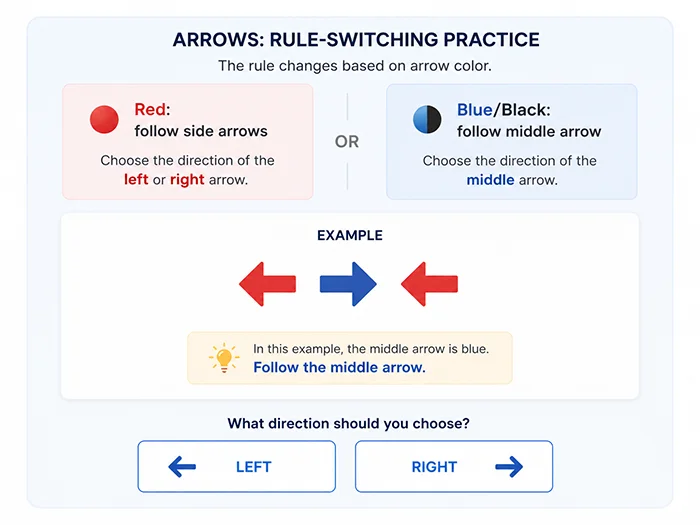
Keypress is blunt. It checks if you can wait, then go hard, then stop cleanly. Lengths are more subtle. It tests your ability to detect small visual differences without letting reward cues derail your focus.
Candidates often misplay these because they disrespect them. They see simple mechanics and assume the task is trivial. It is not. Simple mechanics make impulsivity more, not less, visible.
In practice, keep reminding yourself:
Memory and planning games reveal how you balance patience with execution. Tower tasks favor brief pauses to map out sequences before acting, while digit recall improves with consistent techniques such as chunking or rhythm. Both reward process over impulse. With practice, you develop controlled thinking, planning just enough, then acting cleanly, leading to more reliable performance under pressure and steady cognitive improvement over time.
The tower game rewards efficient sequencing. Many candidates move too early because they think speed alone looks strong. Usually, a short pause helps more. You want to visualize at least the next few moves before touching the structure.
That is why tower practice should not feel frantic. You are building a pattern of brief planning followed by clean execution.
Memory tasks punish casual rehearsal. If you stare at the numbers and hope they stick, your results will vary too much. Better candidates use a method. Chunking, spoken rhythm, visual grouping, or paired repetition can all help if used consistently.
This is one of the easiest areas to improve through repetition because the gains often come from process, not talent alone.
The Pymetrics faces game is where many candidates become overconfident. They assume emotion recognition is intuitive, so they do not practice it seriously. That is a mistake.
Good Pymetrics faces game practice sharpens your eye for subtle cues around the eyes, brow, and mouth. It also helps you avoid overrelying on the story when context is included. The strongest candidates do not guess fast just because a label looks close enough. They compare expression, tension, and context together.
This is where the idea of emotional intelligence in facial recognition becomes important. You are not simply spotting a smile or a frown. You are distinguishing between nearby emotional states that can look similar under time pressure.
Useful habits for this game:
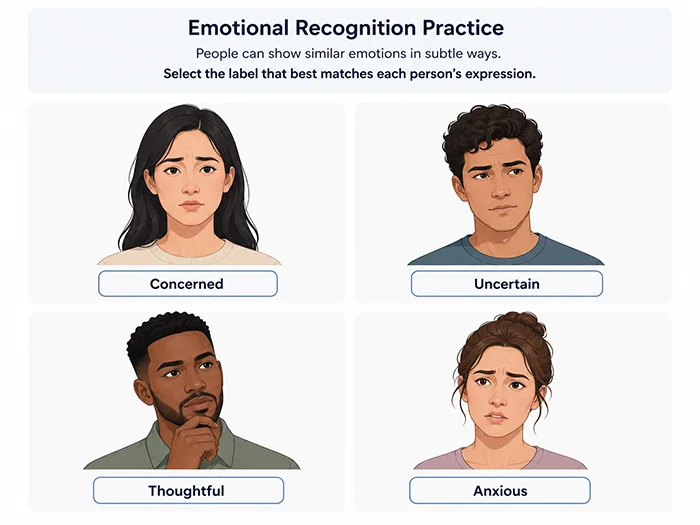
A lot of candidates ask for examples of Pymetrics games because the games make more sense when you see them in action. Below are original practice-style scenarios designed to help you think the right way.
You have three balloon colors in rotation.
You are now on a yellow balloon. You have pumped 8 times.
What is the strongest approach?
A. Keep pumping aggressively because yellow always looks safest
B. Collect now because you already have a useful gain and enough signal
C. Pump once and definitely collect after that because every yellow must follow the same pattern
D. Stop using yellow because one future burst would ruin the whole game
Best reasoning
B is usually the strongest judgment. You have enough evidence that yellow tends to allow more room, but not enough reason to behave recklessly. A ignores moderation. C treats probability like certainty. D is too emotional.
A red set of arrows appears. The middle arrow points right. The side arrows point left.
What response rule should guide you?
A. Press right because the middle arrow is the clearest shape
B. Press left because red means follow the side arrows
C. Wait because conflicting arrows mean no input
D. Switch based on how quickly the arrows appeared
Best reasoning
B. This is why the Pymetrics arrows game challenges candidates so effectively. Your brain wants to react to the most obvious visual shape, but the rule matters more than instinct.
A face shows raised inner eyebrows, slightly tightened lips, and a tense gaze. The short story says the person is about to receive important feedback at work.
Which label is most plausible?
A. Bored
B. Relaxed
C. Concerned
D. Amused
Best reasoning
C is strongest. Context supports it, but the expression carries the main signal. This is the kind of pattern your Pymetrics faces game practice should help you interpret faster.
You receive extra money in the second round. You may share some, keep all, or even take value away, depending on the version.
What decision tends to look strongest?
A. Always give away the maximum
B. Always keep everything
C. Make a measured decision that reflects fairness without losing all strategic judgment
D. Copy what you did in the first exchange, even if the setup changed
Best reasoning
C. The best response is usually balanced and context-aware.
You see the sequence 4 8 1 9 6 2.
Which method is most effective to strengthen recall under time pressure?
A. Stare harder at the full line
B. Split it mentally into 481 and 962
C. Read only the first and last digit
D. Focus on speed and skip structure
Best reasoning
B. Chunking helps stabilize working memory.
Candidates often ask for Pymetrics answers, but that question needs to be reframed. There are no universal answers that guarantee a strong result for every employer and role.
What exists instead is stronger behavior. That means:
When you think about the assessment that way, your prep becomes much more practical. You stop hunting for cheat codes and start training behavior that actually stands up under pressure.
A real Free Pymetrics Games Practice experience should not be a shallow demo with random clicks and no insight. It should help you diagnose your behavior and improve what matters. That means your prep should give you:
That is the difference between casual exposure and actual prep.
At MyHiringHub, the goal is not to push you into a fake personality. The goal is to help you perform with greater control, consistency, and self-awareness. That becomes especially useful when your upcoming process includes employer-specific pressure, early-career competition, or a role where the behavioral profile matters just as much as the resume.

Rhea works with candidates preparing for game-based hiring rounds in consulting, banking, and early-career recruiting. Her focus is decision discipline, pattern recognition, and role-aware assessment strategy. She is especially strong at helping candidates regulate pace in risk and reaction tasks without losing confidence.

Devin helps candidates improve working memory, visual attention, and task-switching control. His coaching is especially useful for candidates struggling with the stop, arrows, lengths, and digits games. He focuses on method, repeatability, and calm execution rather than rushed shortcuts.

Eliana bridges the gap between assessment performance and later stages of hiring. She helps candidates connect their behavioral profile with the interview stories, workplace traits, and role positioning that follow. Her perspective is especially useful when you want your assessment performance and interview performance to feel aligned.
I thought I needed more courage in the risk games. What I actually needed was control. That shift changed everything.

The biggest help was seeing how my behavior changed after a bad round. I used to get too aggressive after a loss. Practice helped me steady out.
I had been using random free clips online, but they were too shallow. Once I practiced with the actual structure, the games stopped feeling mysterious. My timing improved, especially in the arrows and stop tasks, and I felt much less tense when the real assessment started.
The face game looked easy until I practiced it seriously. I was missing subtle emotion cues all over the place.
Great prep made the assessment feel less like a personality trap and more like a performance task I could manage.
What stood out to me was the quality of explanation after each kind of error. I did not just get more reps. I got a much clearer picture of how I behave under pressure, and that helped me calm down across the whole sequence.
Pymetrics does not reward panic, imitation, or wild guessing. It rewards composure, adaptation, and coherent judgment over time. That is good news if you prepare the right way, because those qualities can improve with focused repetition.
The strongest candidates do not walk in hoping their instincts happen to land well. They practice until their instincts become more disciplined. They train the risk games until caution and confidence stop fighting each other. They train the focus games until boredom no longer causes sloppy reactions. They train the emotion and fairness games until their responses feel stable, human, and credible.
That is what Free Pymetrics Games Practice should help you do.
And that is why MyHiringHub approaches prep as performance sharpening, not gimmick hunting. You want clearer judgment, calmer execution, and a profile that looks more intentional under real assessment pressure. When you build that, the games stop feeling random. They start feeling manageable.
Pymetrics focuses more on behavior than textbook problem-solving. You are being read through decisions, reaction style, learning patterns, fairness, restraint, and emotional judgment rather than through standard multiple-choice logic alone.
Enough to recognize the mechanics, settle your pace, and spot your weak habits. The goal is not endless repetition. The goal is reliable control.
A strong prep routine usually works best when it includes:
Yes. Many candidates feel awkward on the first run because the format is unfamiliar. Improvement usually comes quickly once you understand what the game is tracking and stop treating each round like a random gamble.
Usually, yes. The core games stay similar, but the strongest behavioral profile can shift based on the role. Here is the practical difference:
No. That is why copying somebody else’s style can backfire. Strong candidates stay authentic, but they also understand the job context and avoid extreme behavior that weakens their consistency.
Keep it simple. Review your approach to the main games, stop overloading yourself, and protect your focus. A calm mind is usually more valuable than one last round of frantic practice.
That depends on your weak spots, but many candidates benefit most from concentrated work on the balloon, arrows, stop, and faces tasks. Those games often expose instability in risk control, rule-switching, impulse regulation, and emotional reading more quickly than candidates expect.