A Mechanical Aptitude Practice Test helps candidates train for hiring assessments used in maintenance, manufacturing, utilities, transportation, construction, engineering support, public safety, and technical apprentice roles. These exams check how well you understand basic mechanical ideas and apply them to practical situations. You may see levers, pulleys, gears, springs, pressure, fluids, electricity, tools, spatial diagrams, and equipment behavior.
The challenge is not only knowledge. It is an interpretation. A diagram may look simple, but the question may ask which object moves first, which gear turns faster, which side of a lever balances, or which tool fits the task. Candidates who rush often pick the answer that looks familiar rather than the one that follows the mechanical rule.
MyHiringHub helps candidates practice with structure, so mechanical aptitude test prep feels practical instead of random. The goal is to build the habits needed for a real technical job screening test: read the setup, identify the principle, test the answer, and move with control.
Start Mechanical Practice Today
Employers use these assessments because many technical jobs require safe, practical reasoning. A maintenance technician may need to diagnose a belt issue. A plant operator may need to understand pressure changes. An apprentice may need to work with hand tools, diagrams, and basic physics. A technician may need to judge how a pulley system changes force.
This is why the Mechanical Aptitude Practice Test is useful for more than one career path. It supports candidates preparing for a workplace mechanical evaluation, an industrial skills evaluation, a manufacturing skills assessment, or an engineering recruitment exam. The test can also appear in apprentice hiring, military technical roles, mechanical maintenance hiring, and energy sector screening.
Many candidates have real hands-on ability but lose marks because the test presents mechanical ideas visually. A mechanic may understand tools well, but still struggle with an abstract gear diagram. A student may know formulas, but miss a practical rotation question. Good preparation connects both sides: mechanical systems understanding and exam style reasoning.
Mechanical tests usually reward practical logic more than advanced math. You do not need to be a full engineer to answer well. You need enough basic mechanical knowledge to see what is happening in the image and predict the result.
A mechanical assessment can feel broad because it combines several skill areas into a single exam. The exact mix depends on the employer and role, but most tests assess practical reasoning, diagram reading, simple calculations, and physical cause-and-effect.
| Skill area | What it tests | Example task |
|---|---|---|
| Force and motion | How objects move when a force is applied | Predict which cart moves faster |
| Levers and balance | Torque, fulcrum distance, and weight | Find the missing mass on a beam |
| Gears and pulleys | Direction, speed, and mechanical advantage | Choose the direction of the final wheel |
| Electricity | Current, resistance, open circuits, and components | Identify what happens when a switch opens |
| Fluids and pressure | Hydraulic and pneumatic behavior | Compare the pressure in the two chambers |
| Tools and equipment | Practical tool selection and use | Choose the tool for a specific repair |
| Spatial reasoning | Visual rotation, assembly, and matching | Select the correct rotated part |
These are the technical reasoning question types that appear most often across mechanical hiring tests. Some questions are simple, while others combine two or three ideas at once. That is why mechanical comprehension practice questions should be reviewed with explanations, not only answer keys.
A strong practice routine also includes a mechanical principles quiz for fast recall. When the basic rule is automatic, the diagram becomes easier to read.
Candidates often ask about the mechanical aptitude scoring system to understand how many questions they can miss. The honest answer is that scoring depends on the test provider, employer, job level, and candidate pool. Some employers use a fixed score. Others compare your performance to that of a group of applicants. Some place more value on completion rate, while others focus on accuracy by topic.
The mechanical aptitude passing score is usually not something candidates can control directly. What you can control is section readiness. If the test includes gears, electricity, tools, and spatial items, weak performance in one area can reduce your overall standing even when another area feels strong.
The mechanical aptitude test time limit also varies. Some assessments take under a minute per item. Others allow more time because the questions contain detailed diagrams. Timed practice matters because mechanical items often require visual comparison before calculation. A candidate who knows the concept but spends too long reading the image can still run out of time.
A practical benchmark during preparation is this: you should be able to answer easier mechanical items quickly, so you have more time for diagrams with multiple moving parts. That is where a mechanical aptitude test simulator can help. It gives you practice with pacing, not just content.
A Mechanical Aptitude Practice Test should train recognition, reasoning, and review. Random question banks can help a little, but candidates usually improve faster when practice follows a clear sequence.
Start with a free mechanical aptitude mock test to identify your baseline. Then use focused drills to repair weak areas. After that, use timed practice to check if your method holds when the exam clock is active. If you need a written reference, a mechanical aptitude study guide PDF can be useful for revisiting formulas, diagrams, and rules. A complete preparation setup can include:
The best results come from reviewing why the correct answer works. If you memorize only the option, a small change in the diagram can undermine your confidence. If you understand the rule, the next version of the question becomes manageable.
Many candidates spend too much time on the topics they already like. A better approach is to divide the test into mechanical families and make sure no major area is neglected.
Levers often appear because they test balance, force, and distance in a single image. If one side has more weight or greater distance from the fulcrum, it creates a greater turning effect. When solving, compare the product of the weight and the distance. You rarely need complicated formulas, but you do need the habit of checking both sides carefully.
Gears test direction and speed. Meshed gears turn in opposite directions. Gears connected by a belt can turn in the same direction unless the belt crosses. Smaller gears usually rotate faster than larger gears when connected in a pair. These mechanical reasoning shortcuts save time when diagrams are crowded.
Pulley questions check how the force is shared. More supporting rope segments usually reduce the force needed to lift a load, but the rope must travel farther. Do not count every wheel blindly. Count the rope segments actually supporting the load.
Basic electrical questions may ask about open and closed circuits, resistance, current, voltage, bulbs, switches, and simple components. An open switch breaks the path. A series circuit has one path. A parallel circuit gives current more than one path.
Hydraulic and pneumatic questions examine how force travels through liquids or air. Hydraulic systems use a liquid that is difficult to compress, so force can be transferred effectively. Pneumatic systems use compressed air and often appear in machinery operation aptitude assessments.
Tool questions are practical. You may need to identify the tool used for gripping, cutting, measuring, loosening, tightening, or aligning. These items may seem easy, but candidates without recent shop experience may hesitate.
A balanced routine will include real mechanical aptitude examples across all these topics, not only your strongest area.
The following sample items are original mechanical comprehension examples created for practice. Some include image placeholders because the visual is required for the question to make sense.
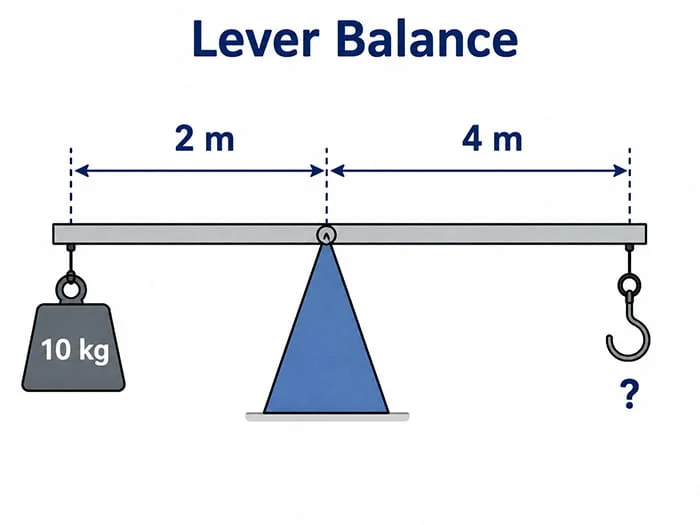
What weight should be placed on the right hook to balance the lever?
A. 3 kg
B. 5 kg
C. 10 kg
D. 20 kg
Answer:
B. 5 kg
Explanation
Balance depends on the turning effect. The left side has 10 kg at 2 meters, giving 20 kg · m of turning effect. The right side is 4 meters away, so a 5 kg mass produces the same turning effect. This question tests a core idea in engineering mechanics: force and distance work together.
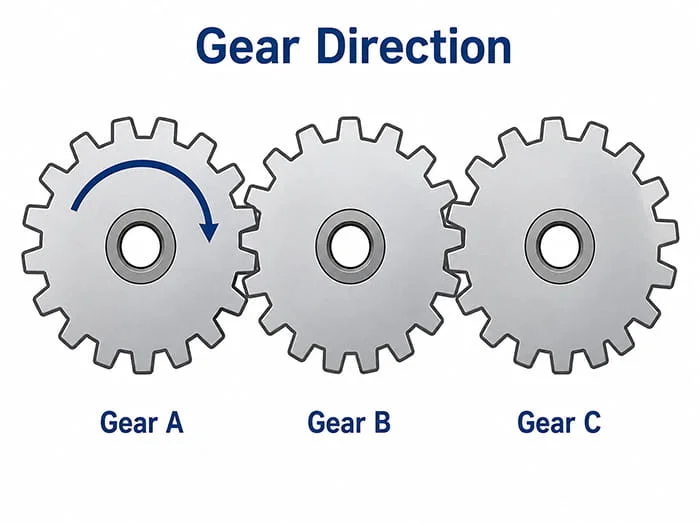
If Gear A turns clockwise, which direction will Gear C turn?
A. Clockwise
B. Counterclockwise
C. It will not move
D. Impossible to tell
Answer:
A. Clockwise
Explanation
Gear A turns Gear B in the opposite direction. Gear B then turns Gear C in the opposite direction again. Two direction changes bring Gear C back to clockwise.
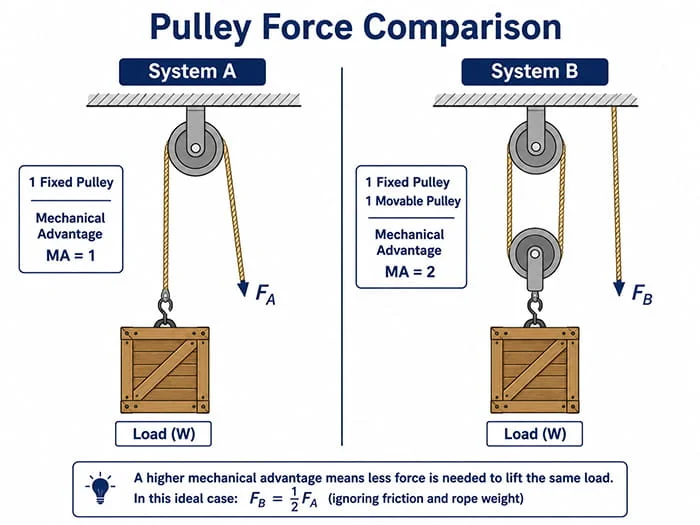
Which system requires less pulling force to lift the same crate?
A. System A
B. System B
C. Both require the same force
D. Neither system can lift the crate
Answer:
B. System B
Explanation
The movable pulley increases mechanical advantage because more rope segments support the load. System B requires less pulling force, though more rope must be pulled.
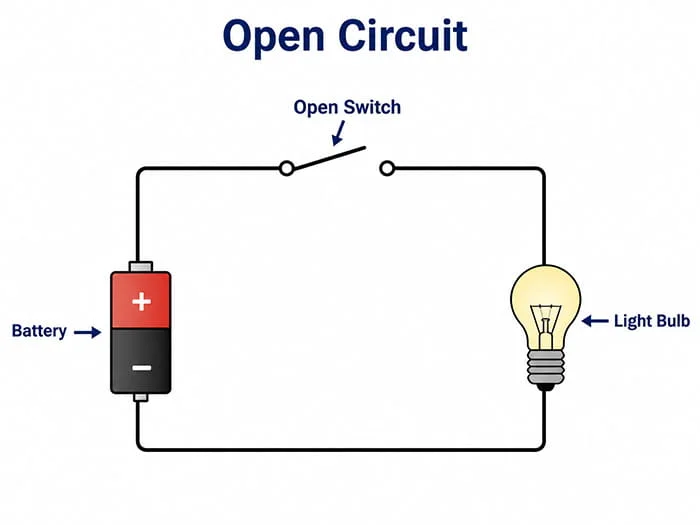
What happens to the bulb?
A. It lights normally
B. It becomes brighter
C. It does not light
D. It flashes on and off
Answer:
C. It does not light
Explanation
An open switch breaks the path, so current cannot complete the circuit. The bulb does not light.
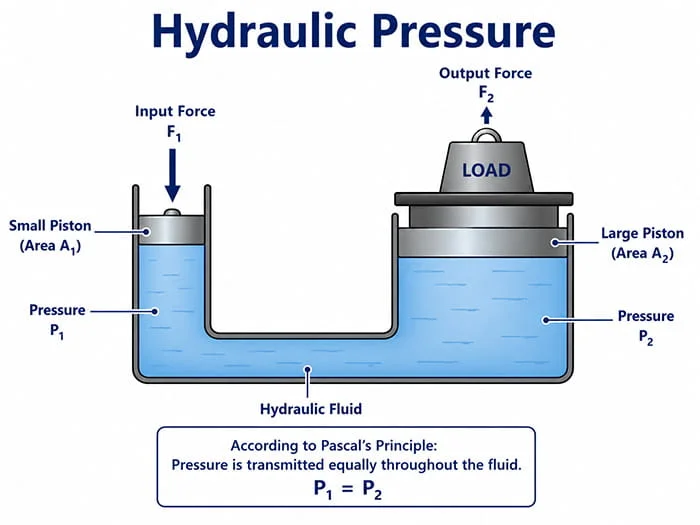
What is the main advantage of this hydraulic setup?
A. It converts liquid into electricity
B. It can multiply force through fluid pressure
C. It removes all friction
D. It makes the smaller piston heavier
Answer:
B. It can multiply force through fluid pressure
Explanation
Hydraulic systems use fluid pressure to transfer force. A larger output piston can create a greater lifting force than the input force, depending on piston area.
A technician needs to accurately measure the outside diameter of a metal rod. Which tool is most appropriate?
A. Claw hammer
B. Vernier caliper
C. Pipe wrench
D. Hacksaw
Answer:
B. Vernier caliper
Explanation
A vernier caliper is used for accurate measurement of outside diameter, inside diameter, and depth. Tool recognition questions often connect practical workshop knowledge with maintenance technician aptitude.
Mechanical diagrams can trick candidates because the picture contains more information than the question needs. The answer usually comes from one key relationship: which side is heavier, which gear touches, which rope supports the load, which path allows current, or which surface creates friction.
A reliable method is to name the action first. Is something rotating, balancing, sliding, lifting, compressing, or flowing? Then identify the mechanical rule. For a lever, compare torque. For gears, count direction changes. For pulleys, count supporting rope segments. For circuits, check if the path is complete. For fluids, compare pressure and piston area.
This is one reason free mechanical aptitude practice tests with answers can be helpful only when explanations are included. The explanation teaches the rule behind the diagram. Without that rule, the next diagram may look completely new.
Candidates preparing for the engineering logic assessment should also slow down on first contact with the visual. Ten extra seconds spent reading the diagram can prevent a wrong answer being chosen too quickly.
The same Mechanical Aptitude Practice Test can support several hiring routes, but each role may emphasize different skills. A manufacturing applicant may see machinery and tools. An electrical apprentice may face more circuit questions. A maintenance candidate may see equipment troubleshooting questions and repair scenarios. An engineering support candidate may see more items on spatial reasoning tests and on applied physics.
A mechanical assessment can feel broad because it combines several skill areas into a single exam. The exact mix depends on the employer and role, but most tests assess practical reasoning, diagram reading, simple calculations, and physical cause-and-effect.
| Career path | Likely focus | Best practice angle |
|---|---|---|
| Maintenance technician | Tools, pulleys, belts, hydraulics, circuits | Troubleshooting scenarios and visual diagrams |
| Manufacturing operator | Machinery motion, safety logic, basic mechanics | Equipment behavior and process reasoning |
| Apprentice electrician | Circuits, current, resistance, switches | Electrical diagrams and component function |
| Mechanical apprentice | Gears, levers, springs, tools | Mechanical principles and shop logic |
| Engineering support | Forces, motion, spatial reasoning | Diagram interpretation and calculations |
| Public safety technical roles | Practical mechanics and quick judgment | Mixed topic practice under time limits |
The right preparation should match the role you want. A candidate applying for maintenance work should not rely solely on school-style physics. A candidate applying for an engineering pathway should not ignore shop reasoning. The strongest preparation blends practical and conceptual work.
MyHiringHub supports this by helping candidates work through mechanical aptitude prep materials that feel relevant to actual hiring screens.
Many candidates ask how to prepare for the mechanical aptitude test formats after they receive an assessment invitation. The best answer is to start with a diagnosis, then narrow the work.
Begin with a short mixed assessment. Do not study first. You need an honest starting point. After that, separate mistakes by category. A missed gear item is not the same as a missed circuit item. A wrong lever answer may mean you forgot torque. A wrong tool answer may mean you need a practical shop review. Use this preparation rhythm:
This method works better than doing long tests every day. Long tests measure your level. Focused repair improves it.
Engineering aptitude preparation tips should also include sleep, timing, and a clean setup. Do not practice only when tired. Do not use answer explanations as passive reading. Cover the answer, solve the problem, then compare your method with the explanation.
The common mistakes in mechanical aptitude exams are usually preventable. Candidates often know enough to answer correctly, but the test format creates small traps.
One common issue is treating every image like a memory test. You do not need to remember everything on the screen. You need to identify the mechanical relationship. Another issue is using everyday instinct when the diagram requires a principle. For example, a larger gear may look more powerful, but it may rotate more slowly than a smaller gear connected to it.
Some candidates skip labels, arrows, or units. This is dangerous. A small arrow can define the direction of a full gear chain. A distance label can change the answer in a lever question. A switch gap decides if the bulb lights.
Other candidates treat the exam like a math test. Some questions do need calculation, but many rely on practical rules. If you overcalculate, you lose time and still may miss the visual clue.
A final mistake is practicing only easy examples. Easy items build familiarity, but harder diagrams train decision quality. You need both.

Grant is a mechanical assessment coach focused on maintenance, manufacturing, and apprentice hiring screens. He helps candidates break diagram-based questions into simple movement rules and practical decisions.

Vivian works with candidates preparing for technical and engineering hiring tests. Her approach connects basic physics with workplace examples, so candidates understand why a principle matters in a real machine or system.

Omar specializes in test pacing and answer review for technical candidates. He helps applicants reduce careless errors by building habits of repeatable reading, diagramming, and elimination.
I had hands-on experience, but the diagrams slowed me down. The explanations helped me turn what I already knew into test answers.

The pulley and lever practice made the biggest difference. I stopped guessing and started checking the actual support points and distances.
I used the mechanical aptitude mock test online first and realized circuits were my weak area. Once I focused there, my practice scores became much more stable.
The tool questions were more useful than I expected. I work around equipment, but I had never practiced tool selection in a timed test format.
The sample questions felt practical. The best part was the answer reasoning because it showed the rule behind each diagram.
I was preparing for a maintenance role and needed something more focused than general aptitude. The mechanical topics matched the kind of screening I expected.
Before your assessment, review the core ideas rather than trying to cover every possible question. Go back to levers, gears, pulleys, circuits, springs, fluids, pressure, tools, and spatial matching. These topics appear often because they reveal how you think about real systems.
On the day of the test, read the question before studying every detail in the image. The question tells you what to notice. If it asks about direction, follow contact points. If it asks about balance, compare weight and distance. If it asks about current, check for a complete path. If it asks about pressure, compare height, area, or force depending on the setup.
Do not spend too long on one item. Mechanical tests often include a mix of easy, medium, and hard questions. The best use of time is to collect the points you can answer cleanly, then handle the harder diagrams with the remaining time.
A Mechanical Aptitude Practice Test works best when it changes how you think, not only how many questions you see. With the right practice, the exam becomes less about guessing and more about applying simple principles with confidence.
A Mechanical Aptitude Practice Test is a training tool for mechanical reasoning exams used in technical hiring. It covers diagrams, tools, force, motion, gears, pulleys, electricity, fluids, and equipment behavior.
No. Most mechanical aptitude exams focus on basic mechanical principles and practical reasoning. Engineering knowledge can help, but clear reading of diagrams and rule-based thinking matter more.
A diagram can include extra details that distract you. The key is to identify the action first, such as rotation, lifting, balancing, sliding, or current flow. Once you know the action, the correct mechanical rule becomes easier to apply.
Start by finding your weakest topic. Then complete short drills on that one area before taking another mixed test. This works better than repeating full tests without reviewing mistakes.
A free test is a useful starting point. It shows your baseline and helps you see the format. For full readiness, you usually need timed practice, topic drills, answer explanations, and review across multiple mechanical areas.
Translate your hands-on knowledge into diagram rules. For example, if you understand a wrench, connect that to leverage. If you understand belts, connect that to rotation and motion transfer. Practice helps turn real experience into test performance.
They should match the skills, not copy the exact wording. Strong practice should include realistic diagrams, multiple-choice answers, time limits, and explanations that show why the correct option follows the mechanical principle.