The DDI assessment is used by employers seeking a deeper look at leadership potential, workplace judgment, reasoning ability, and role readiness. It can appear in hiring, promotion, development, succession planning, and management screening. Unlike a standard aptitude quiz, DDI testing often combines cognitive tasks with work behavior, team judgment, communication, and leadership decision-making.
A candidate may face an adaptive pattern test, a leadership inventory, a situational judgment section, a career battery, an inbox simulation, or interview style exercises. The exact mix depends on the employer and role level. A frontline supervisor candidate may receive a different experience than a sales leader, emerging manager, or executive candidate.
Strong preparation should develop two abilities simultaneously. First, you need to quickly recognize the test format. Second, you need to respond in a way that reflects sound workplace judgment. MyHiringHub helps candidates practice the DDI assessment test with realistic examples, explanations, and structured review, so each section feels less unfamiliar before the real screen begins.
DDI assessments are commonly linked to leadership selection, promotion decisions, development planning, and high-potential identification. They can help employers compare how candidates think, communicate, decide, and handle workplace demands. A strong candidate is not judged by one answer alone. The broader pattern matters.
The Development Dimensions International competency framework usually places strong attention on leadership behaviors such as coaching, delegation, planning, problem analysis, collaboration, gaining commitment, and judgment. That is why DDI practice should not focus only on abstract patterns. It should also prepare you for practical leadership moments.
| DDI area | Candidate task | What to practice |
|---|---|---|
| Adaptive reasoning | Complete visual patterns | Rotation, movement, shading, sequence rules |
| Career battery | Respond to work style and judgment items | Consistency and role aligned judgment |
| Readiness assessment | Show leadership potential | Coaching, delegation, priorities, accountability |
| Inbox simulation | Reply to workplace messages | Prioritization and written judgment |
| Insight inventory | Reflect behavior and development signals | Self awareness and balanced ratings |
| Skills test | Answer role specific questions | Job knowledge and operational judgment |
A good DDI testing methodology gives employers a fuller view of how someone may behave on the job. For candidates, that means practice must feel practical and disciplined. You need to know how to read the intent behind a question, not only the wording on screen.
The DDI Adaptive Reasoning Test is often referred to as the DDI ART test. It usually checks figural reasoning, which means you solve patterns using shapes rather than words. The task may involve rotation, missing pieces, shading changes, symbol movement, or matrix based logic. Because the test is adaptive, difficulty can shift based on your performance.
This section rewards calm pattern recognition. Do not stare at every detail at once. Look for one rule, confirm it, then search for a second rule. Many missed items happen because candidates see one pattern and stop too early.
A strong DDI Adaptive Reasoning Test sample should help you practice the logic, not memorize the picture. Here are two original examples.
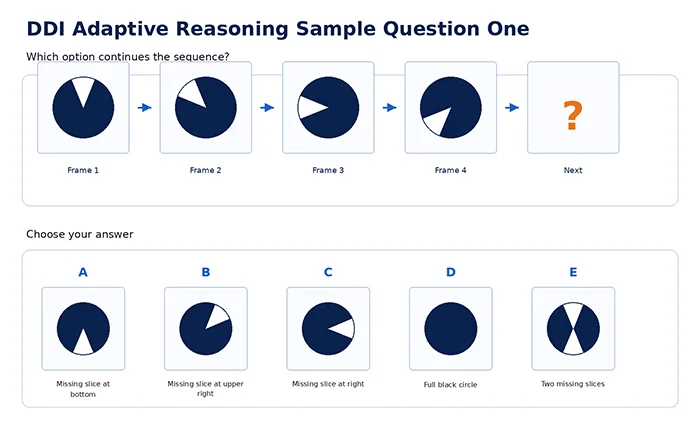
Which option continues the sequence?
A. Missing slice at the bottom
B. Missing slice at upper right
C. Missing slice at right
D. Full black circle
E. Two missing slices
Correct answer
A. Missing slice at the bottom
Explanation
The missing slice moves one step counterclockwise in each frame. The next position after the lower left is the bottom. This is a common visual reasoning habit: track position change first, then check shape or color changes.
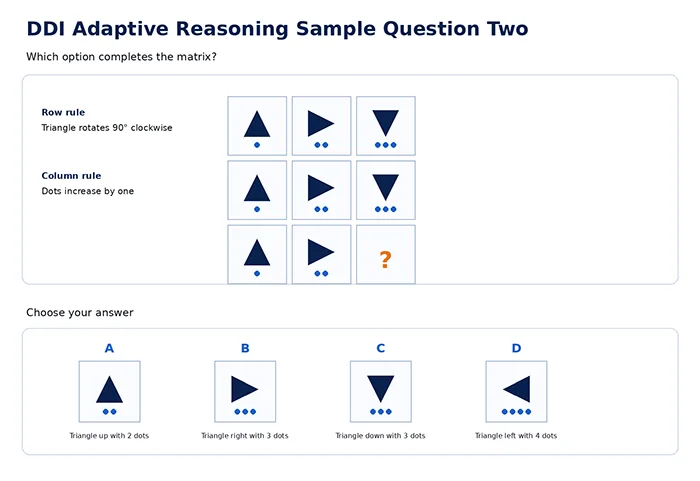
Which option completes the matrix?
A. Triangle facing up with two dots
B. Triangle facing right with three dots
C. Triangle facing down with three dots
D. Triangle facing left with four dots
Correct answer
C. Triangle facing down with three dots
Explanation
The triangle follows the rotation pattern within the row, while the dots follow the column count. The missing cell must satisfy both rules. DDI multiple-choice test prep should train you to check every visible rule before selecting an answer.
The Career Battery is often used for high-volume screening, early leadership identification, and role fit decisions. It may include personality style questions, experience items, and workplace scenarios. Candidates often underestimate this test because it looks simple. That is a mistake.
A leader career battery study guide should help you understand how traits appear across repeated items. If you answer as highly organized in one section but later show poor follow-through in another, the pattern can look weak. Balance matters. Honest answers matter. Role fit matters too.
Professional career battery practice should focus on three areas: how you manage yourself, how you work with others, and how you make decisions when goals conflict.
Rate the statement.
I keep track of commitments carefully and follow up before others need to remind me.
A. Strongly disagree
B. Disagree
C. Neutral
D. Agree
E. Strongly agree
Best response guidance
For leadership or project-based roles, Agree or Strongly agree may reflect a strong work style if it is true for you. This item likely connects with reliability, conscientiousness, and ownership. Avoid selecting the highest option across every item unless it genuinely describes your pattern.
You are leading a small team. A dependable employee has missed two internal deadlines. The work is not client facing yet, but other team members are now waiting.
What is the best response?
A. Ignore it because the employee is usually reliable
B. Ask the employee what is blocking progress and agree on a recovery plan
C. Move all future work away immediately
D. Announce the missed deadlines during the team meeting
Correct answer
B
Explanation
This answer deals with the issue early without overreacting. It shows coaching, accountability, and problem solving. A weak leader avoids the issue. An overly harsh leader damages trust before understanding the cause.
Readiness assessments are often used when employers want to know if someone can step into a leadership role or grow into one with focused development. This can include DDI Leader Ready preparation, DDI Manager Ready practice test work, and DDI frontline leader assessment style activities.
These assessments may include realistic scenarios, open ended responses, role plays, planning tasks, or leadership decisions. They are often built around the gap between current behavior and future role demands. That is why identifying leadership gaps DDI style requires more than checking if someone sounds confident. It looks at how a candidate handles coaching, delegation, conflict, priorities, and decision quality.
The accelerated growth assessment that DDI candidates may face can also highlight development needs for high-potential employees. The goal is not only selection. It can support targeted growth after assessment results are reviewed.
A new supervisor on your team is avoiding difficult conversations with direct reports. Performance problems are increasing, and the supervisor keeps saying the team needs more time.
What should you do first?
A. Take over all conversations personally
B. Coach the supervisor on how to prepare and conduct the conversations
C. Warn the supervisor that their role may be reviewed
D. Tell the team to improve without involving the supervisor
Correct answer
B
Explanation
The best leadership response builds capability while addressing the issue. Taking over may solve the moment, but it does not develop the supervisor. A readiness assessment often rewards coaching, ownership, and practical follow-through.
A department has three urgent needs: a customer escalation, a staffing shortage, and a budget review due tomorrow. Your manager asks how you will proceed.
Which response is strongest?
A. Handle the budget first because it has a due date
B. Ask the team to work late and complete everything
C. Triage customer risk, assign staffing coverage, and reserve a focused block for the budget review
D. Delay the customer issue until staffing is stable
Correct answer
C
Explanation
This answer shows prioritization and planning. It does not treat every issue equally. It protects the customer, handles immediate staffing risk, and keeps the budget task moving. Leader readiness work often measures how well you organize competing responsibilities.
A DDI situational judgment test may ask you to choose the most effective or least effective response to a realistic workplace problem. The strongest option usually balances people, business impact, communication, and accountability. The weakest option often avoids responsibility, acts without information, or ignores relationships.
DDI behavioral simulation exercises can go deeper. You may need to write a response, plan an action, conduct a role-play, or handle a manager-style situation. These are designed to reveal behavior, not just opinion.
A team member publicly challenges your decision during a meeting. Their tone is frustrated, but they raise a valid operational concern.
Most effective response
A. Ask them to stop interrupting and move on
B. Acknowledge the concern, pause the final decision, and review the risk after the meeting
C. Change the decision immediately to avoid disagreement
D. Tell them feedback should only be given privately
Correct answer
B
Explanation
This answer keeps control of the meeting while respecting useful information. It also avoids public embarrassment and prevents a rushed reversal. Good judgment is rarely passive or impulsive.
A direct report tells you they feel overlooked for assignments. You believe assignments have been fair, but the employee sounds discouraged.
What is the best next step?
A. Explain that assignments are fair and end the discussion
B. Ask for examples, discuss goals, and review future opportunities together
C. Promise the next major project immediately
D. Tell them other employees have the same concern
Correct answer
B
Explanation
The best response listens, gathers details, and creates a practical path. It does not make an empty promise. It also does not dismiss the concern. This type of item is closely related to coaching and relationship management.
Some DDI leadership exercises place candidates inside a realistic workday. You may receive emails, memos, requests, complaints, scheduling conflicts, data summaries, and employee issues. A DDI interactive inbox simulation tests how you prioritize, write, delegate, and make decisions with limited time.
Executive in-basket exercise tips usually begin with classification. Sort items by risk, urgency, stakeholder impact, and action owner. A message requiring immediate customer protection should not be treated the same as a routine update. Your written response should be clear, calm, and action-oriented.
Inbox item
Subject: Client Delivery Delay
A project manager emails you at 8:10 AM. A client delivery due at noon may slip because two files are missing approval. The account director is unavailable until 11:30 AM.
What should your reply include?
A. Ask the project manager to wait for the account director
B. Request the approval details, assign a backup reviewer, and ask for a client impact update by 9:00 AM
C. Tell the client the delivery will be late
D. Ignore the email until the account director returns
Correct answer
B
Explanation
The response creates movement, protects the timeline, and requests client impact details. It does not passively wait or announce a delay before confirming the facts.
Inbox item
Subject: Employee Complaint About Schedule Fairness
An employee says weekend assignments are not being rotated fairly. The schedule is due today. Two supervisors disagree about how the rotation was handled.
What is the strongest action?
A. Approve the current schedule because it is due today
B. Ask HR to handle it without review
C. Check the rotation record, speak with both supervisors, and communicate a fair decision before posting
D. Remove the complaining employee from weekend work
Correct answer
C
Explanation
This answer uses facts before action. It also protects fairness and communicates before the schedule is posted. In-basket tasks often reward candidates who organize information before deciding.
DDI Insight Inventory style assessments often support development planning. They can help employers and leaders understand work preferences, leadership tendencies, strengths, and possible gaps. This is not always a pass or fail experience. It may be used to guide coaching, promotion readiness, or professional development.
A candidate should approach these questions with credibility. Overly perfect self ratings can look unrealistic. Low self ratings across important traits may reduce confidence in readiness. The stronger approach is honest, role-aware, and consistent.
Rate the statement.
I adjust my communication style when a team member needs more clarity or direction.
A. Strongly disagree
B. Disagree
C. Neutral
D. Agree
E. Strongly agree
Best response guidance
For a leadership role, a higher rating can be strong if it reflects your real behavior. This item may connect with coaching, empathy, and communication flexibility. A candidate should think about real examples before selecting an answer.
Your team receives feedback that project updates are too vague for senior stakeholders. What would you most likely do?
A. Keep the same format because the team understands it
B. Ask stakeholders what decisions the update should support, then revise the format
C. Add more detail to every section
D. Send fewer updates so stakeholders read them more carefully
Correct answer
B
Explanation
The best response connects communication to stakeholder needs. Adding detail without purpose can make updates harder to read. Good leaders improve clarity by matching information to decision making.
DDI Skills Tests may appear in role specific hiring for areas such as service, retail, healthcare, finance, administration, or technical operations. These tests check practical knowledge tied to the position. Some employers may also use a DDI operational judgment test to assess work decisions in a realistic setting.
The best preparation depends on the role. A customer service applicant may need conflict-handling and policy judgment skills. A manager may need to schedule, delegate, and analyze problems. A finance candidate may need accuracy, controls, and awareness of compliance.
A customer requests an exception to a policy. The exception could solve the complaint quickly, but it may create an unfair result for other customers.
What is the best response?
A. Approve the exception to close the complaint
B. Reject the request without explanation
C. Review the policy, explain the reason clearly, and offer any approved alternatives
D. Ask the customer to contact another department
Correct answer
C
Explanation
This response respects policy while still helping the customer. It protects fairness and keeps communication professional.
You notice a recurring reporting error that has not caused major harm yet. Fixing it will require time with two busy teams.
What should you do?
A. Wait until the error causes a serious issue
B. Document the pattern, estimate risk, and recommend a correction plan
C. Correct only your own reports
D. Tell the teams they need to be more careful
Correct answer
B
Explanation
A practical leader does not wait for preventable damage. This answer demonstrates problem analysis, documentation, risk thinking, and a realistic path to improvement.
DDI assessment test scoring is not always a simple public score with one visible percentage. Depending on the employer, results may be reviewed as competencies, readiness indicators, development needs, benchmark comparisons, or behavioral evidence. For simulations, trained reviewers may look at the quality of actions, written responses, prioritization, and leadership behavior.
That is why reliable DDI testing frameworks are often built around repeated signals rather than one isolated response. A candidate who shows good judgment in one item but avoids accountability in several others may still raise concerns. Consistency carries weight.
The DDI Assessment Test can also support promotion decisions because employers want evidence that a person can handle the next level of responsibility. A strong result can indicate readiness, while a mixed result may suggest skills that need development before a larger role.
MyHiringHub focuses on practical preparation because candidates need more than definitions. They need realistic practice, sample answers, and guidance that explains why one response is stronger than another.

Serena is an organizational assessment coach focused on leadership judgment, simulation performance, and competency based preparation. She helps candidates translate workplace experience into stronger responses during DDI-style exercises.

Graham works on abstract reasoning and visual problem solving. His coaching helps candidates break pattern questions into rotation, movement, shading, and matrix rules without guessing.

Leona supports candidates preparing for manager and frontline leader screens. She works on coaching scenarios, delegation choices, communication habits, and balanced self-ratings.
“I had practiced abstract questions before, but the DDI examples felt different because the patterns used more than one rule. The explanations helped me slow down, check each rule, and stop choosing the first answer that looked close.”

“The inbox exercises were the most useful part for me. I realized I was answering too quickly without assigning ownership or asking for follow-up details.”
“The Career Battery guidance helped me stay consistent without trying to sound perfect.”
“I was preparing for a team lead promotion. The sample scenarios helped me think more like a manager, especially around coaching and delegation.”
“I liked that the practice did not treat every question like a trick. Some answers were about balance, and the explanations made that clear.”
“The DDI Manager Ready style examples were close to the kind of thinking I needed. I felt more organized when handling competing priorities.”
The DDI Assessment Test is a group of hiring and development assessments used to evaluate reasoning, leadership behavior, judgment, work style, and role readiness. The exact format can change by employer and position.
Not exactly. It is a visual reasoning test that uses shapes and patterns instead of written logic. It often requires you to track more than one rule, such as rotation plus shading.
Strong practice should include:
Adaptive reasoning examples
Situational judgment questions
Inbox style decision tasks
Leadership scenario review
Balanced self rating practice
The goal is to build judgment across several formats, not to memorize a single set of answers.
They often ask how you handled a past leadership or workplace challenge. Your answer should include the situation, the action you personally took, and the result. For leadership roles, examples involving coaching, conflict, accountability, and planning are especially useful.
Some inventories may not function like a strict pass-or-fail test, but responses can still influence how employers view fit, readiness, or development needs. Consistent, honest, role-aware answers are safer than trying to create a perfect profile.
Read every item with urgency and risk in mind. Then decide who needs action, what information is missing, and what deadline matters. Strong responses are usually specific, calm, and easy for another person to act on.
Yes, if the preparation builds core skills rather than fixed memorization. Pattern recognition, workplace judgment, prioritization, coaching decisions, and written response quality apply across many DDI formats.
Start as soon as you know a DDI assessment may be part of the process. MyHiringHub can help you start with sample questions and build stronger section-by-section practice before the actual assessment window arrives.